
Can Hail Damage Total a Car? What Happens When the Damage Is Severe
You walk outside after a major hailstorm and barely recognize your vehicle.
The hood is covered in dents. The roof took a beating. The trunk, doors, fenders, and quarter panels are damaged. Maybe the windshield or exterior trim was hit too.
Looking at all that damage raises an obvious question:
Can hail damage actually total a car?
Yes.
A vehicle can be declared a total loss because of hail damage—even when it still runs and drives normally.
But a vehicle covered in hail dents is not automatically totaled.
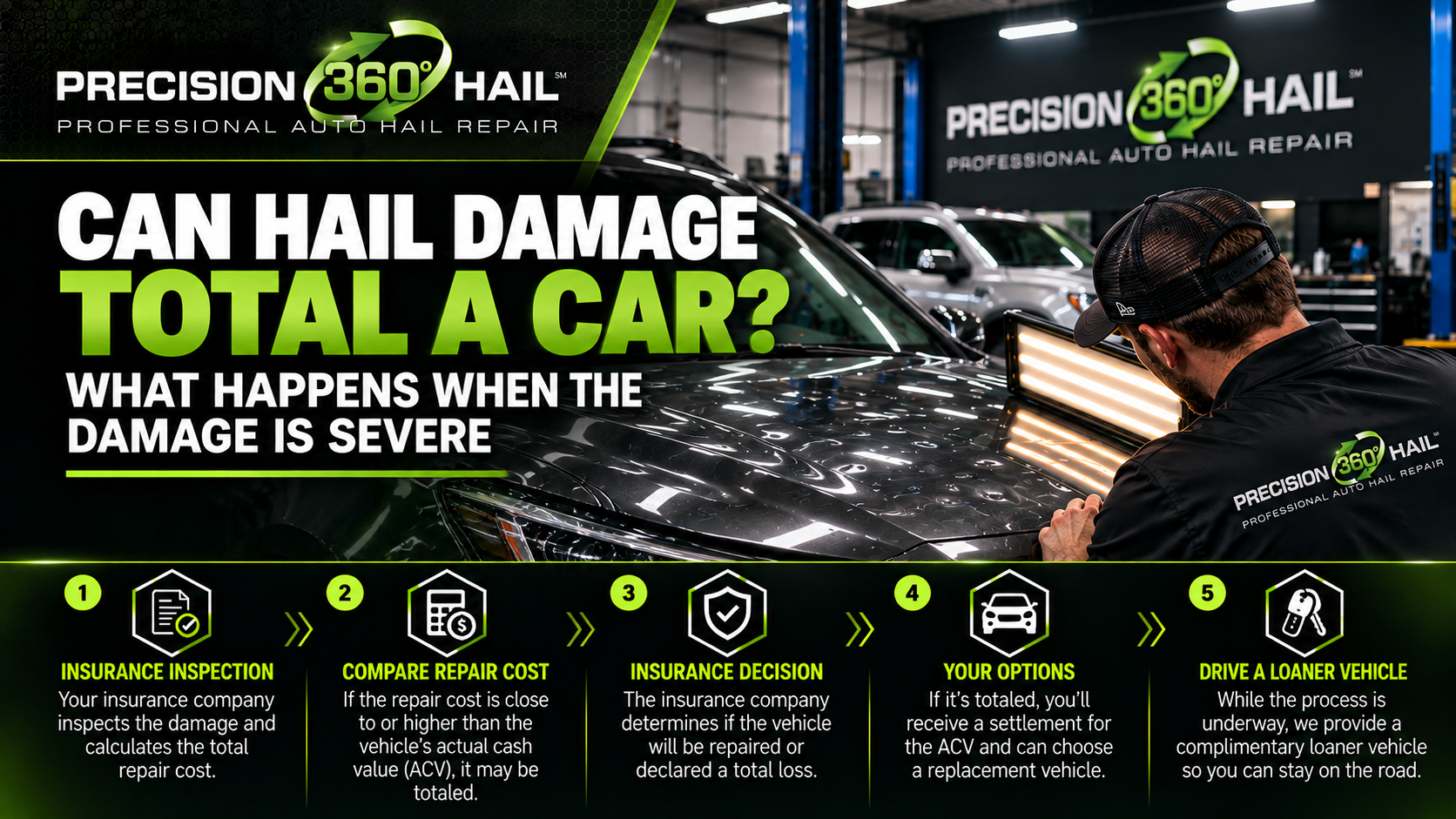
The decision generally comes down to the relationship between the vehicle’s value, the estimated cost of repairing the damage, salvage value, applicable state requirements, and other claim-specific factors. Insurance carriers—not repair facilities—make the total-loss determination. Total Loss Settlement
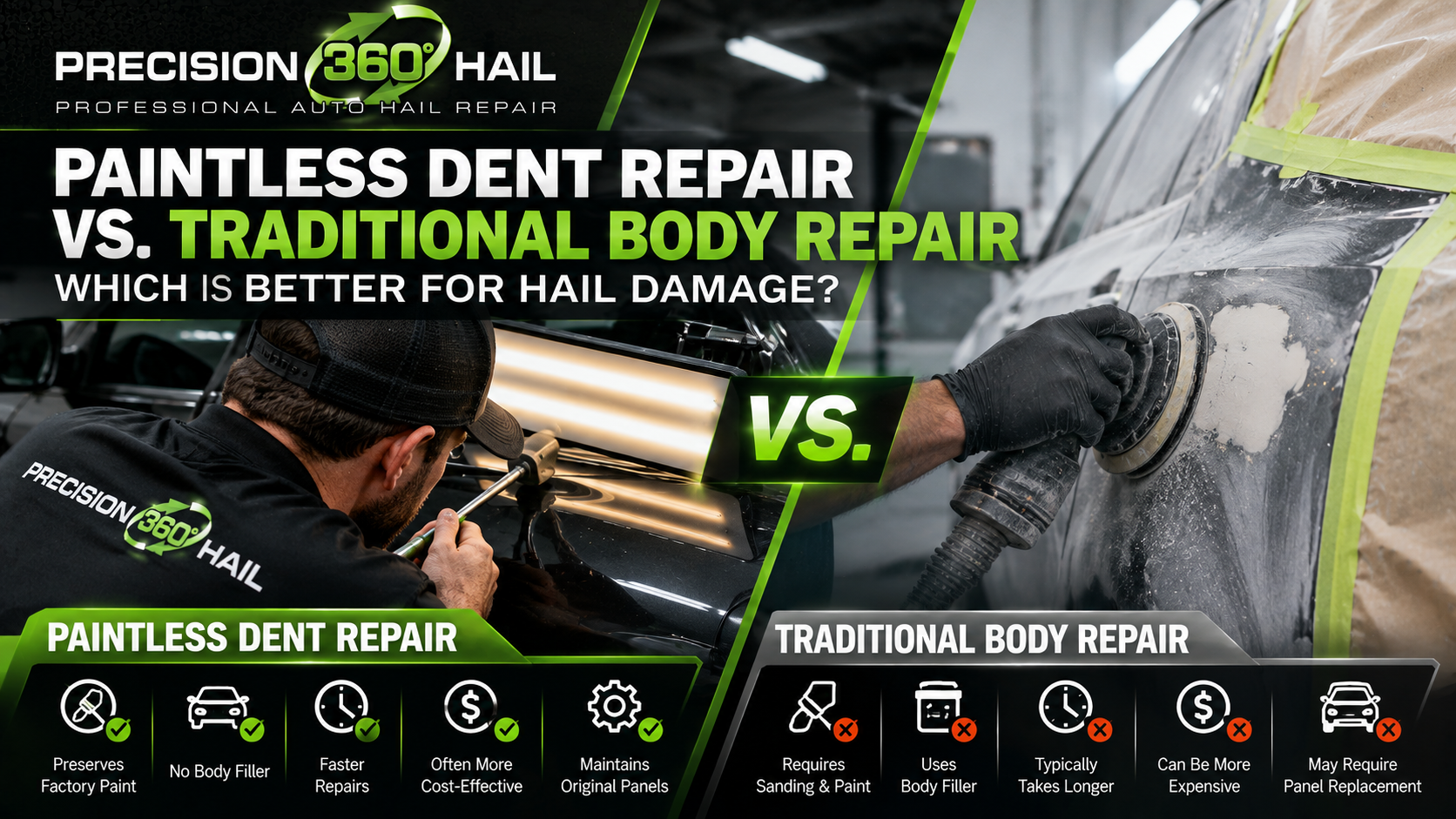
That distinction is important because modern Paintless Dent Repair techniques can sometimes restore extensive hail damage that looks overwhelming at first glance.
Before assuming your vehicle is totaled, here’s what you should know.
What Does It Mean When a Car Is “Totaled”?
A total loss doesn’t necessarily mean a vehicle is physically destroyed or impossible to drive.
It’s primarily an insurance determination.
Generally, an insurance company may declare a vehicle a total loss when repairing it is no longer economically practical relative to the vehicle’s value, when it cannot be safely repaired, or when applicable state requirements call for a total-loss determination.
State Farm, for example, lists three considerations: repair cost relative to actual cash value, whether the vehicle can be safely repaired, and applicable state requirements. Progressive similarly explains that state-specific thresholds can affect when a vehicle becomes a total loss. Total Loss Settlement
That means a perfectly drivable vehicle can potentially be totaled because repairing widespread cosmetic hail damage would cost too much relative to its value.
How Can Hail Damage Total a Vehicle?
Hail can create an unusual type of automotive damage.
A collision might severely damage one portion of a vehicle.
A hailstorm can damage almost every exposed body panel simultaneously.
A severe storm may affect the:
- Hood
- Roof
- Trunk
- Liftgate
- Doors
- Fenders
- Quarter panels
- Roof rails
- Moldings
- Exterior trim
- Lights
- Glass
- Other exterior components
Instead of repairing one damaged area, technicians may be dealing with hundreds of individual dents distributed across the entire vehicle.
As those repair requirements accumulate, the total repair cost can become significant.
If that cost becomes high enough relative to the vehicle’s value and the insurer’s applicable total-loss methodology, the carrier may determine that the vehicle is a total loss.
A Car Covered in Hail Dents Isn’t Automatically Totaled
This is one of the biggest misconceptions about severe hail damage.
A vehicle can look terrible after a storm without necessarily being a total loss.
Why?
Because appearance alone doesn’t determine repairability.
A vehicle may have hundreds of dents while still having:
- Intact factory paint
- Repairable metal
- Original panels suitable for PDR
- Little or no structural damage
- No major mechanical damage
When much of that damage qualifies for Paintless Dent Repair, technicians may be able to restore the panels without automatically replacing and repainting every damaged component.
That’s why the vehicle should be professionally evaluated before conclusions are made about the severity of the repair.
What Is Actual Cash Value?
One of the most important numbers in a total-loss claim is the vehicle’s actual cash value, commonly called ACV.
This generally represents the vehicle’s value immediately before the covered loss.
Insurance companies may consider factors including:
- Year
- Make
- Model
- Mileage
- Pre-loss condition
- Equipment
- Options
- Comparable vehicle values
State Farm says its ACV determination considers factors including year, make, model, condition, equipment, mileage, and options. Progressive similarly describes ACV as market value based on factors such as pre-loss condition, age, options, and mileage. Total Loss Settlement
That means two vehicles with visually similar hail damage could have completely different insurance outcomes.
Why Vehicle Value Matters So Much
Consider two hypothetical vehicles that each require the same amount of hail repair.
One has a relatively high actual cash value.
The other is an older vehicle with a much lower value.
The repair could make economic sense on the higher-value vehicle while pushing the lower-value vehicle toward a total-loss determination.
The dents didn’t change.
The relationship between repair cost and vehicle value did.
That’s why asking whether a certain number of dents will total a vehicle doesn’t have a reliable answer.
There are too many other variables.
Does Repair Cost Have to Exceed the Vehicle’s Full Value?
Not necessarily.
Total-loss calculations can vary by state and insurer.
State Farm says a total loss can result when estimated repairs equal or exceed actual cash value minus anticipated salvage value, when the vehicle can’t be repaired safely, or when state regulations require it. Progressive notes that some states use thresholds based on a percentage of vehicle value. Total Loss Settlement
So there isn’t one nationwide rule saying:
“If repairs hit exactly X percent, the vehicle is totaled.”
The applicable calculation depends on the claim, insurer, vehicle, and jurisdiction.
What Is Salvage Value?
Even a heavily hail-damaged vehicle still has value.
It contains usable parts, materials, mechanical components, and potentially an otherwise functioning drivetrain and interior.
The amount the damaged vehicle is expected to be worth in its post-loss condition is generally referred to as its salvage value.
Salvage value can factor into an insurer’s total-loss calculation.
That’s another reason total-loss decisions aren’t based solely on comparing one repair estimate with a vehicle’s retail asking price.
Can Paintless Dent Repair Prevent a Car From Being Totaled?
Paintless Dent Repair can significantly affect how qualifying hail damage is repaired, but it would be misleading to promise that PDR will prevent a total loss.
The insurance carrier makes that determination.
However, PDR can be particularly valuable for hail damage because qualifying dents can be restored without automatically:
- Replacing the panel
- Sanding the factory finish
- Applying body filler
- Priming the repaired area
- Repainting the panel
When a heavily hail-damaged vehicle has intact paint and repairable panels, PDR may provide an appropriate repair path for much of the damage.
But the vehicle still needs to be evaluated.
What Makes Severe Hail Damage Harder to Repair?
Dent count isn’t the only issue.
Repair complexity increases when hail creates:
- Very deep dents
- Large impacts
- Stretched metal
- Damage along body lines
- Dents in difficult-access areas
- Cracked paint
- Damaged trim
- Broken glass
- Damaged exterior components
- Damage to previously repaired panels
Some panels may qualify for PDR while others require conventional body repair.
Other components may require replacement.
All of those repair requirements contribute to the overall estimate.
Can a Vehicle Need PDR and Traditional Body Repair?
Absolutely.
Severe hail repair doesn’t have to be entirely one method or the other.
For example, the roof, doors, and quarter panels may qualify for Paintless Dent Repair while another panel has an impact severe enough to damage the paint.
The repair plan might therefore include:
- Paintless Dent Repair
- Conventional body repair
- Refinishing
- Replacement parts
- Removal and installation operations
- Glass replacement
- Trim or molding replacement
The appropriate combination depends on the actual vehicle damage.
Who Decides Whether Your Hail-Damaged Vehicle Is Totaled?
Your insurance carrier makes the total-loss determination.
Precision 360 Hail doesn’t decide whether your insurance company totals your vehicle.
Our role is different.
We can inspect the vehicle, evaluate the hail damage, identify repair requirements, determine which damage may qualify for PDR, and provide repair-related documentation.
The insurance company evaluates the claim under its policy, valuation process, and applicable state requirements.
Keeping those roles separate prevents confusion.
What Happens If the Initial Insurance Estimate Is Too Low?
An initial insurance estimate isn’t necessarily the final repair plan.
Widespread hail damage can be difficult to fully assess during an initial inspection or from photographs alone.
A detailed repair-facility inspection may identify:
- Additional dents
- Additional affected panels
- Required access operations
- Damaged components
- Parts
- Different repair methods
- Other necessary repair procedures
When appropriate, Precision 360 can document additional repair requirements through the insurance supplement process.
Those additional costs can potentially affect the overall claim—including whether the insurer ultimately considers the vehicle repairable or a total loss.
The insurance carrier reviews the additional information and makes the coverage and total-loss decisions.
What Happens After the Insurance Company Totals Your Vehicle?
If the carrier determines the vehicle is a total loss, the claim generally shifts away from repairing the vehicle and toward settling its value.
The insurer calculates the settlement according to the applicable coverage and policy.
State Farm states that its total-loss settlement is based on the vehicle’s pre-loss actual cash value and that payment may go to the owner, lienholder, or both, less any applicable deductible. Progressive describes a similar process. State Farm
The exact process depends on your insurer, policy, state, vehicle ownership, and whether a lender or leasing company is involved.
What If You Still Owe Money on the Vehicle?
Having a loan doesn’t change the vehicle’s actual cash value.
This is important.
Suppose you owe $30,000 on your auto loan but the insurer determines that the vehicle’s actual cash value is $25,000.
The insurance company doesn’t automatically increase the vehicle’s value to $30,000 simply because that’s your remaining loan balance.
That can potentially leave a difference between the insurance settlement and what you still owe.
The Texas Department of Insurance explains that ordinary auto policies generally pay the vehicle’s market or actual cash value rather than whatever remains on the loan. Texas Department of Insurance
That’s where GAP coverage may become important.
What Is GAP Insurance?
GAP coverage is designed to address certain differences between what you owe on a financed or leased vehicle and the insurance settlement after a total loss, subject to the particular GAP agreement or policy.
It isn’t automatically included with every auto insurance policy or vehicle loan.
If your hail-damaged vehicle is declared a total loss and you owe more than the settlement, check whether you purchased:
- GAP insurance
- Loan/lease payoff coverage
- Similar protection through your lender, dealer, insurer, or another provider
Progressive notes that without applicable GAP or loan/lease protection, a customer can remain responsible for a balance when the vehicle’s ACV is lower than the amount owed. Progressive
What Happens If the Vehicle Is Leased?
A leased vehicle adds another party to the process: the leasing company.
The leasing company owns the vehicle, and your lease agreement can contain specific requirements regarding damage and total losses.
If the vehicle is totaled, the insurance settlement may be paid to the leasing company according to the claim and lease arrangement.
You should contact both your insurance carrier and leasing company to understand the exact process.
Can You Keep a Hail-Damaged Car After It’s Totaled?
Potentially.
Depending on the state, insurer, lien status, title status, and circumstances of the claim, an owner may be able to retain the vehicle after a total-loss settlement.
But keeping the vehicle usually changes the settlement because the insurer accounts for the salvage value.
In Texas, the Department of Insurance says an owner can tell the insurer they want to keep a totaled vehicle; the insurer will generally subtract the vehicle’s salvage value from the settlement. The vehicle may also receive a salvage title, and additional title requirements can apply before it can legally return to the road. Texas Department of Insurance
Other states can have different rules.
So don’t assume owner retention works the same everywhere Precision 360 serves.
Should You Keep a Hail-Totaled Vehicle?
That’s a decision that needs to be made carefully.
A hail-totaled vehicle can be unusual because the vehicle may still:
- Run normally
- Drive normally
- Have an undamaged interior
- Have no major mechanical problems
- Have damage concentrated primarily on exterior panels
That can make keeping it seem attractive.
But you should understand the consequences before making that decision.
Potential considerations include:
- Reduced insurance settlement
- Salvage-title requirements
- Repair costs
- Future insurability
- Financing or lienholder requirements
- Future resale value
- Registration requirements
- State-specific rules
For example, TDI cautions that a Texas vehicle issued a salvage title may be more difficult to sell or insure later. Texas Department of Insurance
Get the details from your carrier, lender if applicable, and relevant state motor vehicle agency before deciding.
What If You Think the Insurance Company’s Vehicle Value Is Too Low?
You don’t necessarily have to look at the valuation and assume there are no questions you can ask.
Review how the vehicle was valued.
Check details such as:
- Correct year
- Correct make and model
- Correct trim
- Mileage
- Options
- Equipment
- Pre-loss condition
- Comparable vehicles used in the valuation
If something appears inaccurate, discuss it with the insurance carrier.
For Texas claims, TDI advises consumers who disagree with a vehicle valuation to gather evidence such as local comparable vehicle listings, dealer quotes, and documentation of special features or equipment. It also notes that an appraisal process may be available in some circumstances. Texas Department of Insurance
Procedures and rights can vary by policy and state.
What Happens to Your Deductible If the Car Is Totaled?
If the loss is covered and subject to a deductible, that deductible may still apply to the total-loss settlement.
For example, State Farm and Progressive both describe total-loss payments as generally based on actual cash value less an applicable deductible. State Farm
The exact settlement depends on your coverage and claim.
If you have questions about how your deductible is being applied, ask your carrier to explain the settlement calculation.
Does a Total Loss Mean Your Vehicle Was Unsafe?
No.
A vehicle can be totaled for economic reasons even if it remains mechanically operational.
That’s particularly relevant with hail.
Hundreds of dents across multiple panels can create an expensive repair without necessarily damaging the engine, transmission, suspension, or other major mechanical systems.
Conversely, some damaged vehicles may have safety-related issues.
A total-loss designation by itself doesn’t tell you which situation applies.
It’s an insurance and valuation determination—not simply a statement that the vehicle can or cannot move under its own power.
Should You Repair Severe Hail Damage Before the Insurance Company Makes a Decision?
If there’s a possibility the vehicle could be a total loss, coordinate with your insurance carrier and repair facility before authorizing major repairs.
The insurer may need to:
- Inspect the vehicle
- Review the repair estimate
- Evaluate supplemental documentation
- Determine actual cash value
- Complete its total-loss evaluation
Starting substantial repairs before those issues are resolved can complicate the claim.
Precision 360 can inspect the vehicle and help document the repair requirements while the carrier makes its determination.
What Should You Do After Severe Hail Damage?
If your vehicle looks like it took the full force of the storm, don’t assume the outcome from appearances alone.
Start by documenting the damage and reviewing your insurance coverage.
If you’re making a claim, report the loss to your insurance carrier.
Then have the vehicle professionally evaluated.
Precision 360 can inspect:
- Extent of the hail damage
- Affected panels
- Dent quantity and severity
- Paint condition
- PDR repairability
- Conventional repair requirements
- Damaged components
- Overall repair requirements
If you’ve already received an insurance estimate, bring that information with you.
Severe Hail Damage Doesn’t Automatically Mean the End of the Vehicle
A car covered in dents can look devastating.
But appearance alone doesn’t determine whether it can—or should—be repaired.
Paintless Dent Repair can make extensive repairs possible when the paint and metal remain suitable. Other vehicles may require a combination of PDR and conventional repair.
And sometimes the repair requirements become significant enough that the insurance carrier determines the vehicle is a total loss.
You don’t need to make that determination standing in your driveway.
Get the damage professionally evaluated.
Let the repair requirements establish what the vehicle needs, and let the insurance carrier make the coverage and total-loss determination under your policy.
Your Vehicle Took A Beating. Don’t Assume It’s Totaled.