

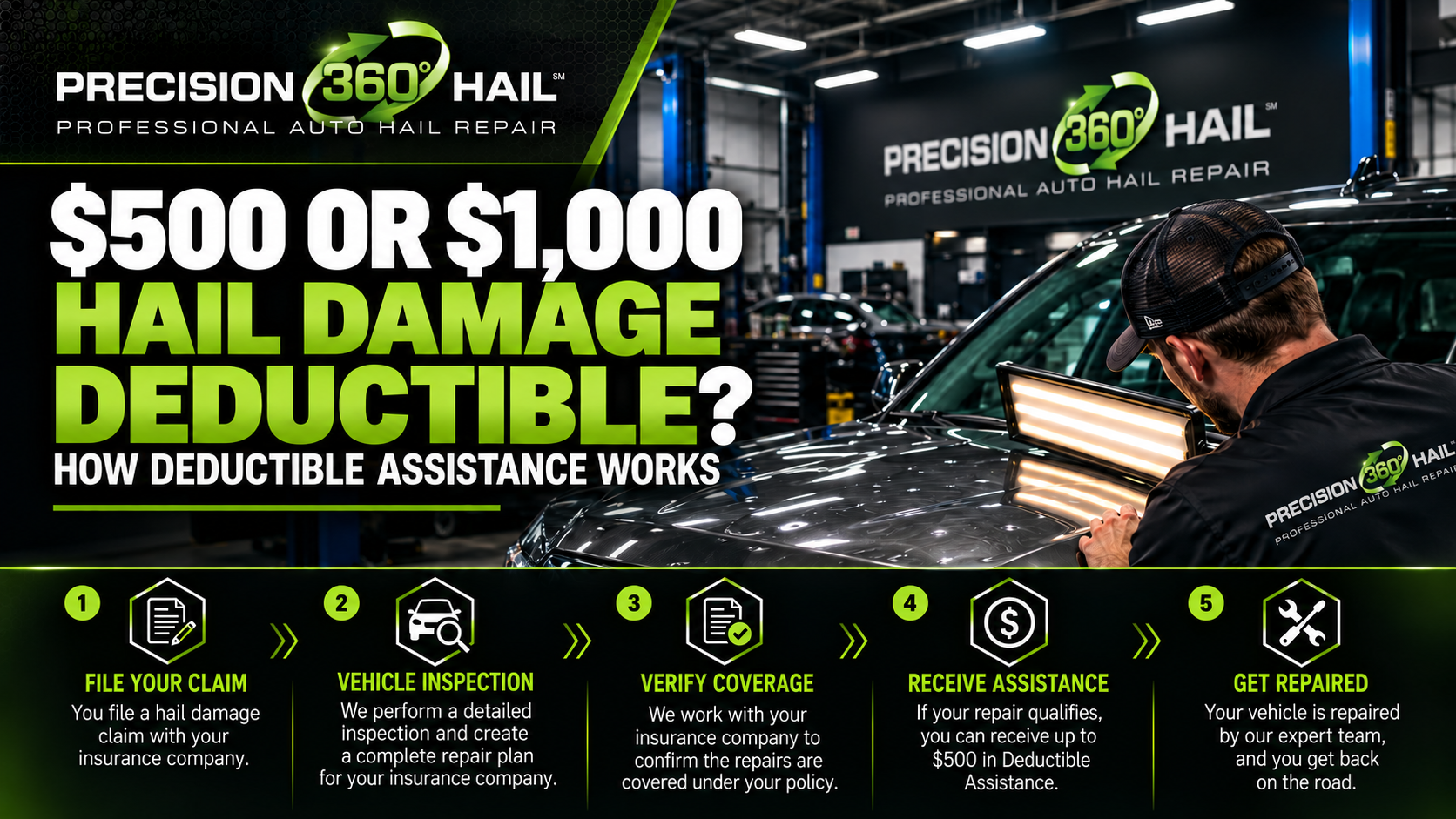
$500 or $1,000 Hail Damage Deductible? How Deductible Assistance Works
Your vehicle gets caught in a hailstorm. You file an insurance claim, the damage is covered, and you’re ready to get your vehicle repaired.
Then you remember one important detail:
Your deductible.
Maybe it’s $500.
Maybe it’s $1,000.
Either way, suddenly you’re wondering how much you’ll have to pay out of pocket—and whether that deductible is going to keep you from getting the hail damage repaired.
It’s a common concern.
Hail damage is generally handled through comprehensive auto coverage when that coverage is included in the policy. Comprehensive coverage typically carries a deductible, which is the amount the policyholder is responsible for before the insurer’s payment applies, subject to the individual policy and claim. Triple-I
Precision 360 Hail offers up to $500 in Deductible Assistance on qualifying hail damage repairs, subject to eligibility and program terms.
Here’s what your deductible means, how it affects a hail damage claim, and what you should know about deductible assistance before scheduling your repair.
What Is an Auto Insurance Deductible?
A deductible is the amount you’re responsible for under your insurance policy when a covered claim is paid.
The Texas Department of Insurance defines a deductible as the amount the insured must pay toward a loss before payment is due from the insurance company. Texas Department of Insurance
For example, imagine your covered hail damage repair is $6,000 and your applicable deductible is $500.
In a simplified example, the deductible would account for $500 of the covered repair amount, with the insurer’s payment determined according to the remaining covered loss and terms of your policy.
If your deductible were $1,000 instead, your responsibility under the policy would be higher.
Actual claims can involve additional factors, so your insurance carrier determines the coverage and payment for your particular loss.
Is Hail Damage Covered by Comprehensive Insurance?
Hail is generally one of the events covered by comprehensive auto insurance.
Comprehensive coverage is designed for certain types of vehicle damage that aren’t caused by a collision, including events such as hail, theft, vandalism, fire, flood, and falling objects. Triple-I
However, simply having auto insurance doesn’t automatically mean you have comprehensive coverage.
Coverage depends on your individual policy.
If you’re unsure, review your declarations page or contact your insurance carrier or agent to determine:
- Whether you have comprehensive coverage
- Your comprehensive deductible
- Whether the hail loss is covered
- Any limitations or exclusions that apply
Precision 360 Hail can assist with the repair-related portion of an insurance claim, but your insurance carrier determines coverage.
Is a $500 Deductible Common for Hail Damage?
Auto insurance deductibles vary by policy.
You may have:
- A $250 deductible
- A $500 deductible
- A $1,000 deductible
- Another amount established by your policy
The deductible is something you generally select when purchasing or modifying coverage.
Higher deductibles can reduce insurance premiums, but they also increase the amount you’re responsible for when you have a covered claim. The Texas Department of Insurance specifically advises consumers to consider how much they could afford to pay after a loss when selecting a deductible. Texas Department of Insurance
That tradeoff may not seem important until a hailstorm actually damages your vehicle.
What Happens With a $500 Hail Damage Deductible?
Suppose your policy has a $500 comprehensive deductible and your hail loss is covered.
The deductible generally represents the first $500 of your responsibility toward the covered loss, subject to the policy and claim.
Precision 360 Hail offers up to $500 in Deductible Assistance for qualifying hail damage repairs.
That means a qualifying customer with a $500 deductible may be eligible for assistance up to the program maximum.
However, eligibility is not automatic.
The actual assistance available depends on the repair and current program terms.
The best approach is to have the vehicle inspected and let Precision 360 determine whether your repair qualifies.
What Happens With a $1,000 Hail Damage Deductible?
A $1,000 deductible doesn’t automatically prevent you from participating in Precision 360’s Deductible Assistance program.
Qualifying repairs may be eligible for up to $500 in assistance.
For example, if a qualifying repair receives the full $500 available under the program, a customer with a $1,000 deductible could still have a remaining financial responsibility.
The important distinction is:
Precision 360’s program offers up to $500 in assistance. It is not a promise to eliminate every deductible regardless of its amount.
Eligibility and the amount available depend on the individual repair and program terms.
What About a Deductible Higher Than $1,000?
The same principle applies.
If your comprehensive deductible is higher than $1,000, you can still ask Precision 360 whether your hail repair qualifies for the Deductible Assistance program.
The maximum assistance available through the program is up to $500, subject to eligibility and applicable terms.
Any remaining amount would still need to be addressed according to your insurance policy, repair agreement, and applicable program terms.
Why Do Insurance Policies Have Deductibles?
Deductibles allow the policyholder and insurance company to share part of the financial risk associated with a claim.
Generally, choosing a higher deductible can reduce what you pay for insurance coverage.
But there’s a tradeoff.
The higher deductible means you’re accepting more financial responsibility when a covered loss occurs.
TDI notes this directly: a higher deductible generally means a lower policy cost but more out-of-pocket responsibility when a claim is filed. Texas Department of Insurance
That can become very real when a severe hailstorm suddenly leaves your vehicle covered in dents.
Does the Deductible Get Added on Top of the Repair Cost?
No.
Your deductible isn’t normally an extra repair charge added on top of the covered repair amount.
It represents the portion of the covered loss assigned to you under the insurance policy.
For a simplified example:
Covered repair amount: $7,000
Applicable deductible: $1,000
The deductible is part of that covered loss calculation rather than an additional $1,000 added to make the repair $8,000.
The actual amount an insurer pays can depend on the policy, estimate, supplements, limits, and other claim-specific factors.
Does the Repair Shop Determine My Deductible?
No.
Your deductible is established by your insurance policy.
Precision 360 Hail doesn’t decide what your deductible is.
Your insurance documents should identify the applicable deductible, and your carrier can explain how it applies to your specific hail claim.
Our role is to inspect and repair the vehicle and assist with repair-related documentation when appropriate.
What Is Deductible Assistance?
Precision 360’s Deductible Assistance program is designed to help qualifying customers reduce the out-of-pocket burden associated with their deductible.
For eligible hail repairs, Precision 360 may provide up to $500 in deductible assistance, subject to current program terms and requirements.
That doesn’t mean every repair automatically receives $500.
And it doesn’t mean every customer’s entire deductible will necessarily be covered.
Eligibility needs to be determined for the individual repair.
Is Deductible Assistance the Same as Waiving a Deductible?
This distinction needs to be handled carefully.
Deductible laws and insurance requirements can vary depending on the type of insurance, transaction, jurisdiction, and how a discount or assistance program is structured. Texas regulators, for example, expressly prohibit certain contractor practices involving waiving, rebating, or absorbing deductibles in covered property-insurance contracting, and warn against inflating repair estimates to offset a customer’s deductible. Texas Department of Insurance
Because Precision 360 works in multiple markets, any deductible-assistance program should be administered in accordance with applicable law, insurance requirements, written program terms, and the actual repair transaction.
What Precision 360 should never do is falsify or inflate a repair estimate to manufacture money for a customer’s deductible.
Does Precision 360 Increase the Insurance Estimate to Cover the Deductible?
No.
The repair estimate should reflect the actual hail damage and legitimate repair requirements.
If additional loss-related damage or necessary operations are discovered that weren’t included in the initial insurance estimate, they can be documented through the appropriate supplemental process for the insurance carrier to review.
That’s different from artificially increasing a repair bill to offset a deductible.
Precision 360’s repair documentation should accurately represent the work required to restore the vehicle.
What Is an Insurance Supplement?
An insurance supplement addresses legitimate repair requirements that weren’t adequately included in an earlier estimate.
For example, a professional hail inspection may identify:
- Additional hail dents
- Additional damaged panels
- Required access operations
- Removal and installation procedures
- Damaged moldings or components
- Different repair methods
- Other necessary repair operations
Those items can be documented and submitted to the insurance carrier for review when appropriate.
A supplement is not a tool for eliminating the customer’s deductible.
It’s part of accurately documenting the repair.
What If My Insurance Check Has Already Been Issued?
You can still bring the vehicle to Precision 360 for an inspection.
Receiving an initial insurance payment doesn’t necessarily mean the entire repair process has already been finalized.
If you’ve already filed your claim, bring whatever information you have available, including:
- Claim number
- Insurance estimate
- Carrier information
- Adjuster or claim contact information
- Relevant claim documents
We’ll inspect the vehicle itself and review the repair requirements.
If legitimate additional repair items need to be documented for your carrier, Precision 360 can assist with the repair-related supplemental process.
Your insurance carrier ultimately determines coverage and payment.
What If My Insurance Estimate Is Lower Than the Actual Repair Requirements?
This is separate from your deductible.
An initial insurance estimate may not always include every item ultimately necessary to repair widespread hail damage.
A detailed inspection may identify additional dents, panels, access procedures, parts, or repair operations.
When appropriate, those additional requirements can be documented and submitted to your carrier for review.
Your deductible doesn’t increase simply because the repair estimate increases. How the deductible applies is determined by the policy and claim.
This is exactly why understanding the difference between repair cost, insurance payment, supplements, and your deductible matters.
They’re related, but they aren’t the same thing.
Do I Have to File an Insurance Claim to Get Hail Damage Repaired?
No.
You can choose to pay for hail damage repair yourself.
Whether filing an insurance claim makes sense depends on your coverage, deductible, extent of damage, vehicle, and individual circumstances.
If you’re unsure how badly the vehicle was damaged, a professional inspection can give you more information before deciding how to proceed.
Should I Avoid Repairing Hail Damage Because of My Deductible?
Don’t make that decision until you understand the extent of the damage and your actual options.
A vehicle that appears to have only a handful of dents may have significantly more damage under proper inspection lighting.
Leaving hail damage unrepaired can also leave visible damage that may affect how the vehicle is evaluated during a future sale or trade-in.
Instead of assuming the deductible makes the repair unaffordable, find out:
- How much hail damage the vehicle actually has.
- Whether the loss is covered by your policy.
- What your deductible is.
- What repair method is appropriate.
- Whether your repair qualifies for Precision 360’s Deductible Assistance program.
Then you can make an informed decision.
Can I Use Deductible Assistance With Paintless Dent Repair?
Potentially, yes.
Eligibility for Precision 360’s program depends on the qualifying repair and program terms rather than simply whether one particular repair technique is used.
Many automotive hail repairs are completed primarily through Paintless Dent Repair (PDR).
When appropriate, PDR allows technicians to restore hail dents while preserving the original factory paint.
More severe damage may require a combination of PDR, conventional repair, refinishing, parts replacement, or other procedures.
Precision 360 determines the appropriate repair method after inspecting the vehicle.
What If I Don’t Know What My Deductible Is?
That’s easy to determine.
Check your auto insurance declarations page and look for the comprehensive coverage associated with your vehicle.
The applicable deductible should be listed there.
You can also contact your insurance agent or carrier and ask:
“What is my comprehensive deductible for hail damage?”
Don’t assume it’s the same as your collision deductible.
Comprehensive and collision coverage can have separate deductibles. Comprehensive is the coverage category that generally includes hail damage. Triple-I
How Do I Find Out If I Qualify for Precision 360 Deductible Assistance?
Start with your vehicle.
Schedule a hail damage inspection with Precision 360 Hail.
If you’ve already filed an insurance claim, bring your claim information and insurance estimate.
We’ll inspect the damage, evaluate the repair requirements, and determine whether your repair qualifies for the current Deductible Assistance program.
If it does, we’ll explain the applicable assistance before moving forward.
No guessing.
No assuming every customer automatically receives $500.
You’ll know what applies to your repair.
Don’t Let Your Deductible Keep You From Getting Answers
A $500 or $1,000 deductible can feel like a major obstacle when your vehicle is suddenly covered in hail dents.
But don’t assume you have to leave the damage unrepaired.
First, find out what you’re actually dealing with.
Precision 360 Hail can inspect your vehicle, determine the appropriate repair method, assist with the repair-related insurance process, and determine whether your repair qualifies for up to $500 in Deductible Assistance.
Don’t Let Your Deductible Hold Up Your Repair.