

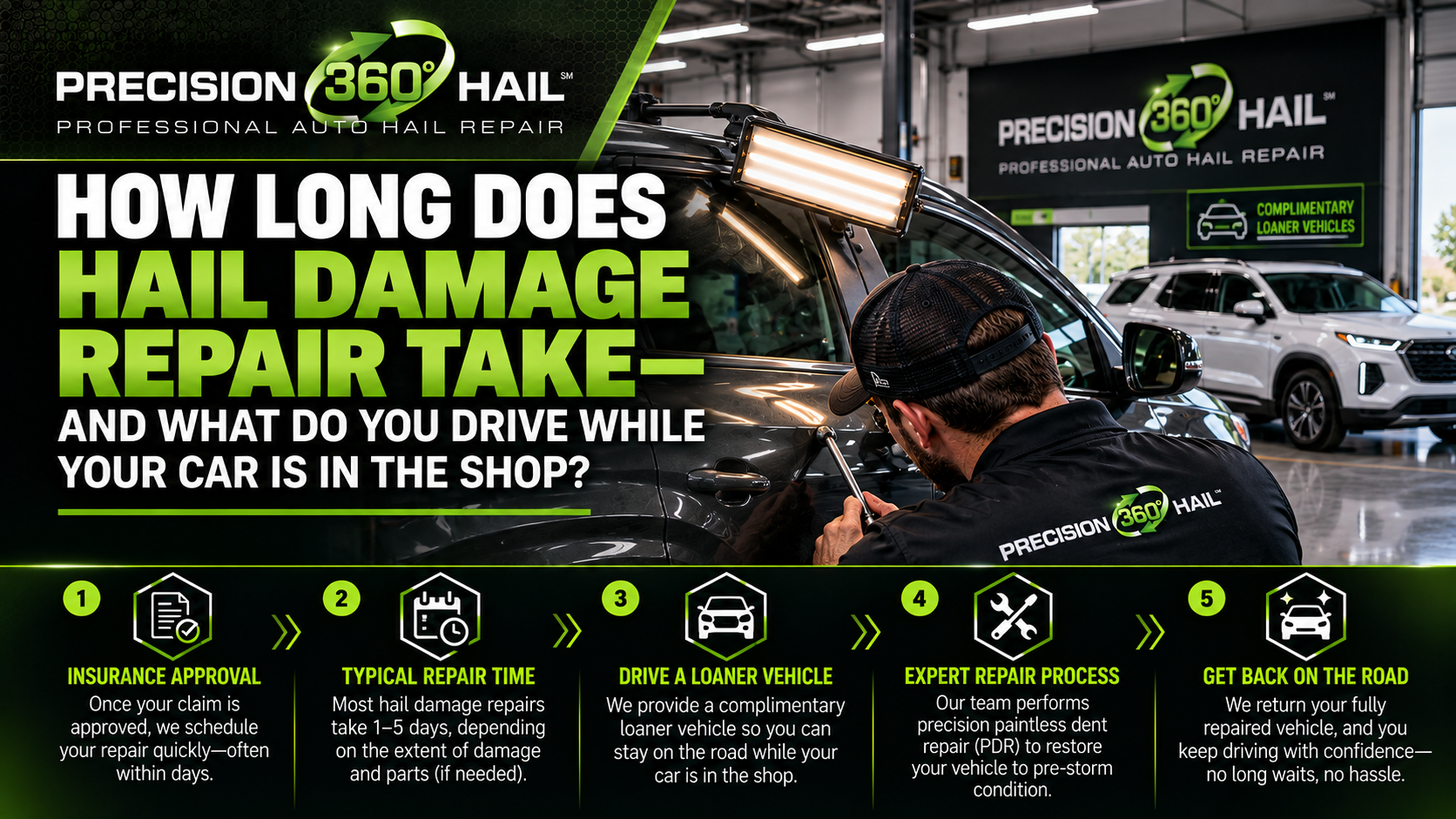
How Long Does Hail Damage Repair Take—and What Do You Drive While Your Car Is in the Shop?
Your vehicle gets caught in a hailstorm. You schedule an inspection, decide to move forward with the repair, and then another practical question comes up:
How long am I going to be without my vehicle?
For most people, that’s not a minor concern.
You still need to get to work. Take the kids to school. Make appointments. Buy groceries. Run errands. Live your normal life.
Unfortunately, there isn’t one universal timeline for automotive hail damage repair.
A vehicle with relatively minor damage across a few panels is very different from one with hundreds of dents across the hood, roof, trunk, doors, fenders, and quarter panels. Some vehicles can be repaired primarily with Paintless Dent Repair, while others may require parts, conventional body repair, refinishing, or a combination of repair methods.
Insurance-related repairs can also involve estimates, supplements, additional documentation, and carrier review.
That’s why Precision 360 Hail determines the expected repair process after inspecting the actual vehicle.
And when your vehicle does need to stay with us, Loaner Car Assistance may be available for qualifying customersto help keep your life moving while we handle the hail damage.
How Long Does Hail Damage Repair Take?
The answer depends on the vehicle and the damage.
There isn’t an accurate one-size-fits-all answer such as “all hail repairs take three days” or “your vehicle will always be finished within a week.”
Repair time can be affected by:
- Number of hail dents
- Size and depth of the dents
- Number of affected panels
- Location of the damage
- Paint condition
- Paintless Dent Repair complexity
- Panel accessibility
- Removal and installation procedures
- Damaged parts or components
- Parts availability
- Conventional body repair
- Refinishing requirements
- Insurance documentation
- Supplemental estimates
- Carrier review
- Overall repair complexity
A professional inspection gives the repair facility much more information about what the vehicle actually needs.
Minor Hail Damage and Severe Hail Damage Are Very Different Repairs
The term hail damage covers an enormous range of vehicle damage.
One vehicle might have several dozen shallow dents concentrated on its hood and roof.
Another vehicle from the same storm could have hundreds of dents covering nearly every exposed panel.
Severe hail can also damage:
- Moldings
- Trim
- Glass
- Lights
- Exterior components
- Painted surfaces
Some impacts may stretch the metal or damage the paint enough that Paintless Dent Repair isn’t appropriate.
Naturally, a vehicle requiring work across nearly every body panel can take longer to repair than a vehicle with substantially less damage.
That’s why the number of days shouldn’t be estimated from the fact that the vehicle “has hail damage” alone.
Paintless Dent Repair Can Affect the Repair Timeline
For qualifying hail damage, Paintless Dent Repair (PDR) is often the preferred repair method.
Instead of sanding the damaged panel, applying body filler, and repainting it, PDR uses specialized tools and techniques to carefully restore the damaged metal while preserving the original factory finish.
When appropriate, this eliminates some of the procedures associated with conventional body repair.
But that doesn’t mean PDR is instant.
A severely hail-damaged vehicle can contain hundreds of individual dents.
Each one requires precision.
Technicians may need to work across the:
- Hood
- Roof
- Trunk
- Liftgate
- Doors
- Fenders
- Quarter panels
The amount of PDR work required directly affects the overall repair timeline.
Hundreds of Dents Require Hundreds of Individual Repairs
It’s easy to look at a hail-damaged roof or hood and think of it as one damaged panel.
From the technician’s perspective, that panel may contain dozens or hundreds of individual impacts.
Each dent has its own:
- Size
- Depth
- Shape
- Location
- Access limitations
- Metal characteristics
Technicians carefully manipulate those damaged areas toward their original shape.
That takes time.
Professional hail repair isn’t about rushing across the panel until the dents are less noticeable.
The goal is to properly restore the damage using the appropriate repair techniques.
Panel Access Can Add Time to the Repair
Technicians can’t always immediately access the backside of a hail dent.
Modern vehicles contain:
- Interior trim
- Headliners
- Wiring
- Braces
- Insulation
- Lights
- Sensors
- Cameras
- Other components
Certain items may need to be carefully removed and later reinstalled to provide appropriate repair access.
For example, repairing roof hail damage may require access behind portions of the headliner.
These removal and installation procedures, often called R&I operations, are part of the overall repair process when necessary.
The exact procedures vary by vehicle.
Some Hail Damage Requires Traditional Body Repair
Paintless Dent Repair is extremely effective for qualifying hail damage, but not every impact can necessarily be repaired using PDR.
Conventional repair may be required when there is:
- Cracked or damaged paint
- Severely stretched metal
- Extremely deep damage
- Damage to previously repaired panels
- Broken components
- Damage requiring panel replacement
- Other conditions that make PDR inappropriate
In those situations, the vehicle may require a combination of PDR and traditional body repair.
Traditional repair can involve additional procedures such as surface preparation, metal repair, refinishing, or replacement parts.
Those operations can affect the overall timeline.
Parts Availability Can Affect Repair Time
Sometimes the metal itself isn’t the only thing damaged by hail.
Large hail can damage exterior components such as trim, moldings, lamps, and other parts.
If a damaged component needs replacement, the repair facility may need to order the appropriate part for that specific year, make, model, and configuration.
Parts availability can vary.
A common component may be readily available, while another part may need to be sourced or ordered.
That’s another reason two apparently similar hail repairs can have different completion times.
Insurance Claims Can Affect the Timeline Too
When hail damage is being repaired through insurance, the repair process can involve more than simply fixing dents.
The carrier may first prepare an initial estimate.
Precision 360 then evaluates the actual vehicle and repair requirements.
If the initial estimate doesn’t include all necessary loss-related damage or repair operations, additional documentation may need to be submitted through the supplement process.
Major auto insurers have established processes for repair facilities to submit supplements when additional loss-related damage or repair requirements are identified. State Farm, for example, describes supplement requests for additional parts, labor changes, repair-versus-replace changes, and damage not included on the original estimate.
Carrier review can therefore become part of the overall repair timeline.
What Is an Insurance Supplement?
A supplement is additional repair documentation submitted to the insurance carrier when necessary repair requirements weren’t adequately represented in an earlier estimate.
With hail damage, that might involve:
- Additional dents
- Additional damaged panels
- Required R&I operations
- Damaged trim or components
- Different repair procedures
- Additional labor
- Parts
- Conventional repair requirements
Precision 360 Hail can document legitimate additional repair requirements and submit that information to the insurance carrier for review when appropriate.
The carrier determines whether the additional items are covered under the policy and claim.
Does a Supplement Mean Something Went Wrong?
No.
Additional repair requirements can sometimes be discovered after the initial estimate.
Progressive explains to customers that additional damage found during repairs isn’t unusual and provides a process for the repair facility to request a supplement when necessary.
With widespread hail damage, detailed inspection and repair planning can reveal requirements that weren’t apparent during an earlier inspection or photo estimate.
The supplement process allows those items to be documented and reviewed.
Can You Speed Up an Insurance Hail Repair?
There are a few things you can do to help prevent unnecessary delays.
If you’ve already filed your claim, have your information available when you bring the vehicle to Precision 360.
That can include:
- Insurance carrier
- Claim number
- Initial estimate
- Adjuster or claim contact information
- Other relevant claim documentation
You can also discuss transportation needs when scheduling your repair rather than waiting until the day you’re ready to drop off the vehicle.
That gives everyone a clearer picture of the repair and logistics before work begins.
Should You Wait to Repair Hail Damage Until You Have a Rental Car?
Not necessarily.
Your transportation options may extend beyond rental reimbursement through your insurance policy.
Precision 360 Hail offers Loaner Car Assistance for qualifying customers while their vehicles are being repaired.
If transportation is one of the reasons you’ve been putting off the repair, talk to us about it when scheduling your appointment.
We’ll determine what options may be available for your repair.
What Is Loaner Car Assistance?
Precision 360’s Loaner Car Assistance program is designed to help qualifying customers stay mobile while their vehicles are undergoing hail damage repair.
Availability and requirements can vary depending on the repair and transportation arrangement.
That’s why we recommend discussing Loaner Car Assistance before dropping off your vehicle.
If you qualify, we can explain the available arrangement and applicable requirements so you know what to expect.
Do You Need Rental Coverage on Your Insurance Policy?
Not necessarily.
Insurance rental reimbursement coverage and Precision 360 Loaner Car Assistance are not the same thing.
Rental reimbursement is optional coverage that can help pay transportation expenses after a covered loss, subject to the limits and terms of the insurance policy. The Insurance Information Institute notes that rental reimbursement coverage is optional and generally subject to daily and total limits.
If your policy doesn’t include rental reimbursement coverage, that does not automatically mean you won’t qualify for Precision 360’s Loaner Car Assistance.
They are separate arrangements.
What If Your Insurance Does Cover a Rental Car?
If your policy includes rental reimbursement coverage, your insurance carrier can explain:
- Whether it applies to your hail claim
- Daily reimbursement limits
- Maximum total reimbursement
- Rental requirements
- How long coverage may apply
Coverage varies by policy.
Precision 360 doesn’t determine your rental reimbursement benefits.
If you’re unsure what you have, contact your carrier or agent and ask specifically about rental reimbursement coverage for your hail claim.
What Do You Need to Receive a Loaner Vehicle?
Requirements depend on the transportation arrangement.
Customers may be required to provide items such as:
- Valid driver’s license
- Proof of insurance
- Contact information
- Other required documentation
There may also be terms governing who can drive the vehicle, fuel, mileage, vehicle condition, return timing, and other responsibilities.
Precision 360 will explain the applicable requirements when arranging transportation.
How Long Can You Keep the Loaner Vehicle?
That depends on the repair and the specific loaner arrangement.
The intent of Loaner Car Assistance is to help qualifying customers maintain transportation while their vehicles are being repaired.
The applicable terms and expected duration should be discussed before the loaner vehicle is provided.
That way, both the repair timeline and transportation arrangement are clear from the beginning.
What Happens If Your Hail Repair Takes Longer Than Expected?
Automotive repair timelines can change.
For example:
- Additional damage may be discovered
- A supplement may require carrier review
- A part may be delayed
- Repair requirements may change
- Additional conventional repair may become necessary
If something affects the expected repair timeline, Precision 360 will communicate with you about the repair and any impact on the transportation arrangement.
The important thing is knowing what’s happening rather than wondering why your vehicle isn’t ready.
Can You Drive Your Vehicle While Waiting for the Repair Appointment?
That depends on the condition of the vehicle.
Many hail-damaged vehicles remain drivable because the damage is primarily cosmetic.
But severe storms can cause more than dents.
Hail can potentially damage glass, mirrors, lights, and other exterior components.
If you’re concerned about whether the vehicle is safe to drive, have the relevant damage evaluated before continuing to use it.
A cracked windshield, compromised visibility, or damaged safety-related component shouldn’t be treated the same as several cosmetic dents in a hood.
Should You Schedule Hail Repair Immediately After a Storm?
After a major hailstorm, repair demand can increase quickly.
Scheduling an inspection sooner gives you an opportunity to understand the damage and begin planning the repair.
That doesn’t mean every hail-damaged vehicle is an emergency.
But waiting simply because you assume you’ll be without transportation can unnecessarily delay the process.
Start with the inspection.
Find out what the vehicle needs.
Then discuss the repair schedule and transportation options.
What Happens When You Bring Your Vehicle to Precision 360?
Our process is designed to keep things straightforward.
Inspect the Damage
We evaluate the vehicle to identify the hail damage and determine the appropriate repair methods.
Review the Insurance Information
If you’ve already filed a claim, we’ll review the repair-related information and existing estimate.
Build the Repair Plan
We determine which areas qualify for Paintless Dent Repair and whether additional repair methods, parts, or procedures are necessary.
Coordinate the Repair
We’ll schedule the vehicle and discuss what to expect during the repair process.
Arrange Transportation When Applicable
If you qualify for Loaner Car Assistance, we’ll review availability and applicable requirements.
Repair the Vehicle
Our technicians complete the necessary hail repairs and document additional repair requirements for insurance review when appropriate.
Complete a Final Quality Check
Before delivery, we perform a final quality inspection of the completed repairs.
How Can You Make the Process Easier?
Before dropping off your vehicle, make sure you understand three things:
What does my vehicle need?
What’s happening with my insurance claim?
What am I driving while my vehicle is being repaired?
Precision 360 can help bring those pieces together.
Instead of dropping your vehicle off and then trying to figure out transportation, discuss Loaner Car Assistance when you schedule your repair.
And if you’ve already filed your insurance claim, bring your claim information with you.
A little preparation can make the entire process much easier.
Your Car May Be in the Shop. Your Life Doesn’t Have to Be.
Hail repair takes as long as necessary to properly address the damage—and that timeline can vary significantly from one vehicle to another.
The number of dents, affected panels, repair methods, access requirements, parts, insurance supplements, and other factors can all influence how long your vehicle needs to remain in the shop.
That’s why Precision 360 doesn’t believe in giving every customer the same generic timeline.
We inspect the vehicle first.
Then we build the repair plan.
And for qualifying customers, Loaner Car Assistance can help keep you moving while we get your vehicle back on the road.
Your Car’s In The Shop. You Don’t Have To Be.