

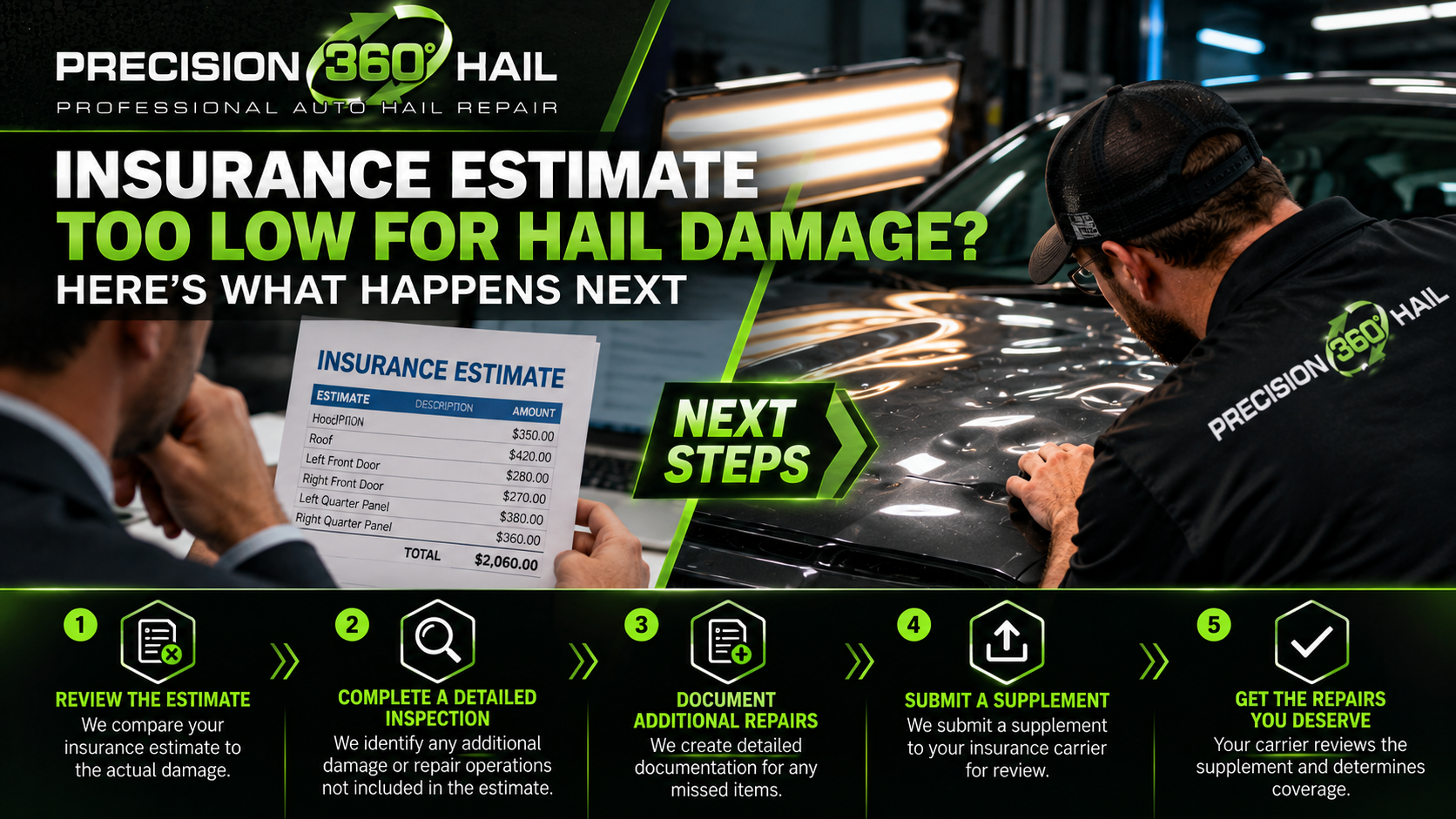
Insurance Estimate Too Low for Hail Damage? Here’s What Happens Next
You filed your hail damage claim. Your insurance company inspected the vehicle—or reviewed photos—and sent you an estimate.
Then you take the vehicle to a hail repair company and hear something you weren’t expecting:
The insurance estimate doesn’t include everything needed to repair the damage.
That can immediately raise questions.
Is something wrong with the claim? Are you responsible for the difference? Does the repair shop need to follow the original estimate? Does this mean your insurance company won’t pay for the additional repairs?
Not necessarily.
An insurance estimate is based on the damage and repair requirements identified when that estimate is written. Additional loss-related damage or necessary repair operations can sometimes be identified later. Major insurers specifically have processes for shops to request updated estimates or supplements when this occurs. State Farm
For a hail-damaged vehicle, that distinction can be especially important.
A storm may leave dozens or hundreds of dents across multiple panels, and accurately evaluating the entire repair can require professional lighting, detailed inspection, and sometimes access to areas that weren’t fully evaluated during the initial estimate.
Here’s what happens when the initial insurance estimate doesn’t match the actual repair requirements.
First: Don’t Panic When the Numbers Don’t Match
An insurance estimate that’s lower than the repair shop’s estimate doesn’t automatically mean you’re facing a huge unexpected bill.
It also doesn’t automatically mean either estimate is wrong.
The two estimates may have been created using different information.
An insurer’s initial estimate may be based on:
- Photographs
- Video
- An exterior inspection
- Visible damage
- Information available at the beginning of the claim
For example, State Farm describes its photo estimate as an initial estimate and states that if the repair facility later identifies additional claim-related damage, the additional damage can be reviewed. Progressive similarly explains that its estimate reflects damage it can see without taking the vehicle apart and that finding additional damage during repairs isn’t unusual. State Farm
The important question isn’t whether the first estimate and repair plan are identical.
It’s whether the additional repair requirements are related to the covered loss and supported by appropriate documentation.
Why Hail Damage Can Be Underestimated Initially
Hail damage is unusual compared with many other types of vehicle damage.
After a collision, there may be one obvious area of impact.
After a hailstorm, damage can be distributed across almost every exposed surface of the vehicle.
That can include the:
- Hood
- Roof
- Trunk
- Liftgate
- Doors
- Fenders
- Quarter panels
- Roof rails
- Moldings
- Trim
- Glass
- Other exterior components
And there may be far more dents than you can see while standing next to the vehicle outside.
Professional Lighting Can Reveal Additional Hail Dents
Paintless Dent Repair technicians commonly use specialized lighting and reflection systems to evaluate dents.
Why?
Because hail dents change the reflection across a panel.
Under the right lighting, subtle distortions that are difficult to see outdoors can become much easier to identify.
A hood that appears to have 20 or 30 obvious dents in ordinary daylight may reveal additional impacts when inspected more carefully.
That’s one reason a detailed repair-facility inspection can produce a different assessment from an initial photo-based or exterior inspection.
It isn’t necessarily about someone suddenly adding damage.
It can simply be the result of evaluating the vehicle in greater detail.
The Initial Estimate May Not Include Every Necessary Operation
Dent count is only one part of a hail repair.
Technicians also need to determine how they’re going to access and repair the damaged panels.
For Paintless Dent Repair, accessing the backside of certain panels may require removal and reinstallation—often called R&I—of certain vehicle components.
Depending on the vehicle and damaged areas, repair procedures can involve components associated with areas such as:
- Headliners
- Interior trim
- Hood insulation
- Lamps
- Moldings
- Exterior trim
- Other components obstructing access
Not every vehicle requires the same operations.
But when an operation is legitimately necessary to complete the covered repair, it needs to be part of the repair plan.
What Is an Insurance Supplement?
A supplement is additional repair documentation submitted when repair requirements differ from what was included in an earlier estimate.
This is an established part of the auto insurance repair process.
State Farm’s current supplement process specifically allows repair facilities to submit requests involving hail damage and identifies categories such as additional parts, labor-time changes, repair-versus-replace changes, and damage not included on the original estimate. Supporting documentation can include an itemized supplemental estimate, photographs, and invoices. State Farm
Progressive similarly states that a supplement may be needed if hidden damage is discovered or the repair facility believes the repair process on the initial estimate should be modified. Progressive
In simple terms:
The original estimate says what was identified initially. A supplement documents additional repair requirements for the insurance carrier to review.
What Can Be Included in a Hail Damage Supplement?
Every claim and repair is different, but supplemental documentation could involve things such as:
- Additional hail dents
- Different dent counts or severity
- Additional damaged panels
- Necessary labor operations
- Required access operations
- Removal and installation procedures
- Damaged moldings or trim
- Replacement components
- Changes in repair method
- Additional conventional repair requirements
- Additional refinishing requirements where applicable
- Other loss-related repair items not included initially
The purpose isn’t to arbitrarily increase the repair bill.
It’s to document what the repair facility believes is actually required to complete the repair.
Does the Repair Shop Just Send the Insurance Company a Bigger Bill?
That’s not how a proper supplement process should work.
Additional repair requirements need to be documented and presented to the carrier for review.
The carrier may request:
- Photographs
- Repair documentation
- An updated estimate
- Parts information
- Additional vehicle information
- A reinspection
Progressive’s published repair procedures, for example, state that it may reinspect a vehicle after a supplement request and then evaluate the additional repair work. Progressive
Precision 360 Hail can assist with this repair-related documentation and communication.
But the insurance carrier retains the authority to determine what is covered under your policy and claim.
What Happens After Precision 360 Submits a Supplement?
The exact process varies by insurance company and claim, but it generally follows a straightforward path.
Additional Repair Requirements Are Identified
Precision 360 identifies damage or repair operations that weren’t adequately represented in the current estimate.
The Additional Items Are Documented
We prepare the appropriate repair information and supporting documentation.
The Supplement Is Submitted
The additional repair requirements are sent to the insurance carrier for review.
The Insurance Company Reviews the Request
The carrier may review the documents remotely or request additional information or a reinspection.
The Repair Plan Is Updated as Appropriate
If additional covered items are approved, they can be incorporated into the updated repair estimate.
The exact process and timing depend on the carrier, policy, damage, and circumstances of the claim.
Does a Supplement Mean the Insurance Company Made a Mistake?
Not necessarily.
This is an important distinction.
It’s easy to see two different numbers and assume someone made an error.
But an initial estimate is created using the information available at that time.
A repair facility may later have:
- Better lighting
- More inspection time
- Different viewing angles
- Access to additional areas
- Vehicle-specific repair information
- Information discovered during the repair process
Progressive explicitly tells customers that additional loss-related damage discovered during repairs isn’t unusual and that the estimate can be updated when needed. Progressive
So the existence of a supplement by itself doesn’t prove the original estimate was handled improperly.
It means additional repair requirements are being presented for review.
Does a Supplement Mean My Insurance Company Will Automatically Pay Everything?
No.
Submitting a supplement is not the same as receiving approval.
The insurance carrier reviews the additional repair items and determines what’s covered according to the policy and circumstances of the claim.
That’s why Precision 360 Hail is careful about the distinction between insurance claims assistance and making insurance coverage decisions.
We can:
- Inspect the vehicle
- Identify repair requirements
- Prepare repair documentation
- Submit supplements when appropriate
- Communicate with the carrier regarding repair-related issues
We cannot determine coverage on behalf of your insurance company.
Your carrier makes that decision.
Will I Have to Pay the Difference?
Not automatically.
If additional repair requirements are related to the covered hail loss and the insurance carrier approves them, the insurer may update its estimate accordingly, subject to the terms of the policy, deductible, limits, and any other applicable provisions.
Major insurers describe this exact process. State Farm says that when a repair shop identifies additional claim-related damage, it can review that damage and pay additional amounts it owes under the claim. Progressive likewise states that additional loss-related damage may lead to reinspection and an updated estimate. State Farm
There can still be circumstances where a vehicle owner is responsible for certain costs.
Those situations depend on the policy and repair, so they shouldn’t be generalized.
Your Deductible Is Different From a Supplement
This is another area that causes confusion.
Your deductible and an insurance supplement are two different things.
The deductible is generally the portion of a covered loss you’re responsible for under your insurance policy.
A supplement addresses additional repair requirements that weren’t included in the previous estimate.
For example, suppose additional covered hail damage is discovered and approved through the supplement process.
That doesn’t normally mean you suddenly have a second deductible simply because the repair estimate increased. Your actual financial responsibility depends on the policy and claim.
Precision 360 Hail also offers up to $500 in Deductible Assistance for qualifying hail repairs, subject to eligibility and program terms.
What If the Insurance Company Wants Another Inspection?
That can be part of the process.
If additional repair requirements are submitted, the carrier may want to inspect or reinspect the vehicle before making a decision.
That doesn’t necessarily mean there’s a problem with your claim.
It’s one method insurers use to evaluate supplemental repair requests.
For example, Progressive’s published supplement guidelines specifically provide for a potential reinspection after additional damage or changed repair requirements are reported. Progressive
Precision 360 can provide the repair-related information necessary for the carrier’s review.
Do You Have to Use the Insurance Company’s Recommended Repair Shop?
Insurance companies may have preferred or network repair facilities, but major carriers also recognize customers’ ability to use other repair facilities.
Progressive, for example, tells customers they can use a network facility or another shop they choose. State Farm’s photo-estimate process likewise tells customers to provide the estimate to the repair shop of their choice. Progressive
Specific rights and requirements can vary by jurisdiction and policy, so questions about your particular claim should be directed to your carrier.
The important thing is choosing a repair facility experienced with the type of damage your vehicle sustained.
For widespread automotive hail damage, that means understanding PDR, dent assessment, panel access, repair planning, and insurance-related repair documentation.
Should You Accept the Insurance Check and Skip the Repair?
That’s a personal decision that can depend on the vehicle, policy, financing or lease agreement, damage, and other circumstances.
If the vehicle is financed or leased, there may also be lender requirements regarding repairs. Progressive notes that lenders may require repairs on financed or leased vehicles. Progressive
Before deciding, it’s worth understanding the actual extent of the hail damage.
A payment based on an initial estimate doesn’t necessarily tell you everything about what would be required to professionally restore the vehicle.
Getting the vehicle inspected gives you more information before making that decision.
What Should You Bring to Precision 360 If You’ve Already Filed a Claim?
If your hail claim is already open, the process is simple.
Bring the vehicle along with any information you have available, such as:
- Insurance company
- Claim number
- Insurance estimate
- Adjuster or claim contact information
- Relevant claim documents
Don’t worry if you don’t understand every line on the estimate.
We’ll inspect the vehicle itself and review the repair-related information.
What If You Haven’t Filed a Hail Claim Yet?
You can still have your vehicle inspected.
You don’t necessarily need an insurance estimate before a repair facility can evaluate the damage.
If you decide to pursue an insurance claim, the policyholder generally initiates the claim with the insurance carrier.
Precision 360 can then assist with the repair-related portion of the process.
That distinction matters.
We’re here to repair your vehicle and document what the repair requires—not to make coverage decisions for your insurance company.
Why Choosing a Hail Repair Specialist Matters
A hail claim can involve much more than identifying several obvious dents.
A severely damaged vehicle may have hundreds of impacts across numerous panels.
The repair facility needs to understand:
- Paintless Dent Repair
- Dent assessment
- Panel accessibility
- Removal and installation operations
- Vehicle construction
- Conventional repair when necessary
- Parts and damaged components
- Repair documentation
- Supplemental estimates
- Insurance-related communication
The repair plan should reflect what the vehicle actually needs.
That’s where an experienced automotive hail repair company becomes important.
Precision 360 Helps Take the Confusion Out of the Repair Process
Receiving an insurance estimate that’s lower than the actual repair requirements doesn’t have to leave you trying to figure everything out yourself.
Precision 360 Hail can inspect the vehicle, compare the damage and repair requirements with the existing estimate, document additional necessary items, and submit supplemental information to the insurance carrier when appropriate.
Your insurance company still makes the coverage decisions.
We focus on the vehicle.
Because the goal isn’t simply to make the repair fit the first estimate.
It’s to accurately identify what your vehicle needs and properly document the repair.
Already Have an Insurance Estimate? Bring It With You.
If you’ve already filed your hail claim, you’re ahead of the game.
Bring us your vehicle, claim information, and insurance estimate.
We’ll inspect the hail damage, evaluate the repair requirements, and help you understand what happens next.
If additional covered repair requirements need to be presented to the carrier, we’ll provide the repair-related documentation necessary for review.
Insurance Estimate Too Low? That Doesn’t Have To Stop The Repair.