
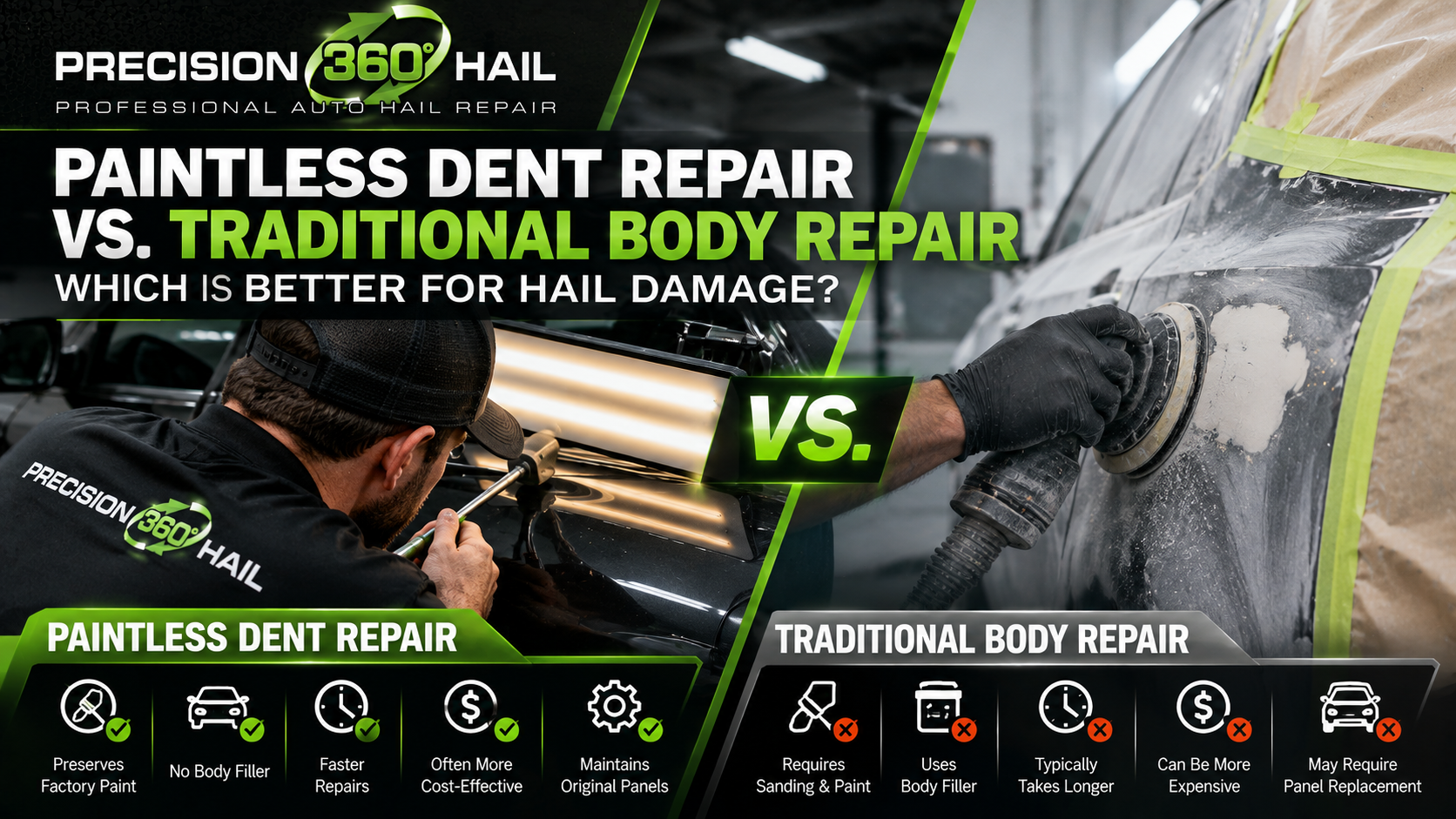
Paintless Dent Repair vs. Traditional Body Repair: Which Is Better for Hail Damage?
Your vehicle gets caught in a hailstorm. The storm passes, and suddenly the hood, roof, trunk, and other panels are covered in dents.
Now comes the important question:
How should the damage actually be repaired?
For many hail-damaged vehicles, Paintless Dent Repair (PDR) can restore qualifying dents without sanding, body filler, or repainting the affected panels. But PDR isn’t the right solution for every type of hail damage.
Sometimes conventional body repair, refinishing, or even panel replacement is necessary.
The best repair method isn’t about choosing PDR or traditional body repair simply because one sounds better. It’s about determining what your particular vehicle needs to be properly restored.
At Precision 360 Hail, automotive hail damage is evaluated panel by panel to determine where Paintless Dent Repair is appropriate and where another repair method may be necessary.
Here’s how the two approaches differ.
What Is Paintless Dent Repair?
Paintless Dent Repair, commonly called PDR, is a specialized repair method used to restore certain dents without sanding the original finish, applying body filler, or repainting the panel.
Rather than covering a dent, a skilled PDR technician works with the existing metal.
Using specialized tools and techniques, the technician carefully manipulates the damaged area toward its original shape.
Depending on the dent and panel, this may involve accessing the backside of the metal or using specialized techniques from the exterior surface.
The process requires precision.
A hail-damaged vehicle can have dozens or even hundreds of individual dents, and each one may respond differently depending on its size, depth, location, and the construction of the panel.
Why PDR Is So Commonly Used for Hail Damage
Automotive hail damage is uniquely suited to Paintless Dent Repair because hail can create widespread dents while leaving the vehicle’s paint intact.
Imagine a vehicle sitting outside during a severe hailstorm.
Hailstones may strike the:
- Hood
- Roof
- Trunk
- Liftgate
- Doors
- Fenders
- Quarter panels
The vehicle may end up with hundreds of dents, yet much of the factory paint may still be undamaged.
Traditional repair methods could require sanding and refinishing numerous areas.
When those dents qualify for PDR, technicians can instead work with the existing panels and preserve the original finish.
That’s one of the biggest reasons PDR has become such an important part of professional automotive hail damage repair.
How Traditional Body Repair Works
Traditional or conventional body repair uses different techniques to restore damaged vehicle panels.
Depending on the damage, the process may involve:
- Sanding
- Body filler
- Metal repair
- Primer
- Refinishing
- Repainting
- Panel replacement
- Replacement of damaged components
These methods aren’t inherently inferior to PDR.
They’re simply designed to address different types of damage.
If a hailstone has cracked the paint or damaged the metal beyond what can reasonably be restored through PDR, conventional body repair may be the appropriate solution.
Likewise, if a panel or component is damaged beyond repair, replacement may be necessary.
The goal should always be to use the appropriate repair method for the actual damage.
The Biggest Difference: Preserving the Factory Finish
One of the primary advantages of Paintless Dent Repair is its ability to preserve a vehicle’s original factory paint when the damage qualifies.
With conventional repair, a damaged area may need to be sanded, repaired, prepared, and refinished.
PDR takes a different approach.
Because the original paint remains intact, technicians work to restore the metal underneath it without unnecessarily disturbing the factory finish.
That means a successful PDR repair can preserve:
- Original factory paint
- Original panels
- Original finish
- Existing factory coatings
For many vehicle owners, that’s a major advantage.
PDR vs. Traditional Repair: Body Filler
Body filler is commonly used in conventional collision and body repair when appropriate.
The damaged surface is repaired, prepared, filled where necessary, shaped, and refinished.
Paintless Dent Repair doesn’t rely on filler to correct qualifying dents.
Instead, the technician works with the original metal itself.
For hail damage that qualifies for PDR, this allows the panel to be restored without adding filler simply to eliminate the appearance of the dent.
Again, that doesn’t make body filler inherently bad.
It means that if the original metal and paint can be restored through PDR, conventional repair may not be necessary for that particular dent.
PDR vs. Traditional Repair: Repainting
This is another major difference.
A qualifying PDR repair does not require repainting the repaired panel.
Traditional body repair may.
When refinishing is necessary, a professional repair facility follows the appropriate preparation and paint procedures to restore the affected area.
But if the factory finish hasn’t been compromised and the dent can be successfully repaired with PDR, avoiding unnecessary refinishing can be an advantage.
When Is Paintless Dent Repair the Better Choice?
PDR is often preferred when the hail damage meets the necessary repair conditions.
That commonly means:
- The paint remains intact
- The metal hasn’t been damaged beyond PDR repairability
- The dent is accessible using appropriate repair techniques
- The panel can be restored without conventional body repair
- Previous repairs don’t prevent safe PDR techniques
When those conditions are present, Paintless Dent Repair can provide an excellent solution for automotive hail damage.
But simply having intact paint doesn’t automatically mean every dent qualifies.
The vehicle still needs to be inspected.
Can PDR Repair Large Hail Dents?
Sometimes.
A common misconception is that Paintless Dent Repair is only useful for tiny door dings and small dents.
Modern PDR techniques can repair some surprisingly significant dents.
However, size alone doesn’t determine whether a dent is repairable with PDR.
A technician also needs to evaluate:
- Dent depth
- Shape
- Location
- Metal stretching
- Panel material
- Body lines
- Access
- Paint condition
- Previous repairs
A relatively large, shallow dent in an accessible area may be a better PDR candidate than a smaller but extremely sharp dent in a difficult location.
That’s why an experienced technician needs to inspect the damage rather than judging repairability from dent diameter alone.
When Traditional Body Repair May Be Necessary
Paintless Dent Repair is powerful, but it has limitations.
There are situations where conventional repair is the appropriate choice.
The Paint Is Cracked or Damaged
PDR is designed to preserve existing paint.
If a severe hail impact has already cracked or significantly damaged the finish, refinishing may be necessary.
The Metal Is Severely Stretched
Large or extremely deep impacts can stretch the metal beyond what can reasonably be restored through PDR alone.
The Panel Has Previous Bodywork
Previously repaired panels may contain body filler or refinished areas.
Those conditions can affect whether PDR techniques are appropriate.
A Component Is Broken
Hail doesn’t only dent sheet metal.
It can damage:
- Moldings
- Trim
- Lights
- Glass
- Exterior components
Broken components may require replacement rather than dent repair.
The Panel Is Beyond Repair
In some cases, replacement may be more appropriate than attempting to repair severely damaged metal.
A professional inspection determines which method makes sense.
Sometimes the Best Hail Repair Uses Both Methods
The choice isn’t always:
PDR or traditional body repair.
Sometimes the correct answer is:
Both.
Imagine a vehicle with extensive hail damage.
The hood and roof may have dozens of dents that qualify for Paintless Dent Repair.
At the same time, one particularly severe impact may have damaged the paint on another panel.
The best repair plan could involve PDR across most of the vehicle while using conventional repair and refinishing only where necessary.
This is why Precision 360 Hail evaluates the entire vehicle rather than trying to force every dent into one repair method.
Does PDR Work on Aluminum Panels?
Paintless Dent Repair can be performed on qualifying aluminum panels, but aluminum and steel behave differently.
The vehicle’s construction and panel material need to be considered when determining the appropriate repair technique.
Modern vehicles can use a combination of materials across different areas of the body.
A technician needs to understand what they’re working with before deciding how the damaged panel should be repaired.
Is Paintless Dent Repair Faster Than Traditional Body Repair?
PDR can eliminate some of the operations associated with conventional repair because qualifying panels don’t need to go through sanding, filling, priming, and refinishing.
However, that doesn’t mean every PDR hail repair is quick.
A severely hail-damaged vehicle can contain hundreds of individual dents.
Technicians may also need to remove and reinstall components to gain proper access to the damaged panels.
The total repair time can depend on:
- Severity of the hail damage
- Number of damaged panels
- Number of dents
- Dent complexity
- Panel access
- Parts requirements
- Insurance-related documentation
- Supplements
- Conventional repair requirements
- Shop scheduling
That’s why it’s better to determine repair time after the vehicle has been professionally inspected.
Does PDR Cost Less Than Traditional Body Repair?
It can in certain situations, but PDR shouldn’t automatically be viewed as the cheap version of body repair.
Professional Paintless Dent Repair is skilled technical work.
A technician repairing widespread hail damage may need to restore hundreds of individual dents across several panels while maintaining the original finish.
The cost depends on the actual damage and repair requirements.
As we covered in our guide to hail damage repair cost, factors such as dent quantity, dent size, affected panels, access, vehicle construction, parts, and repair methods all contribute to the final repair.
The correct question isn’t simply:
Which method is cheaper?
It’s:
Which repair method is appropriate for this damage?
Will PDR Show Up on a Vehicle History Report?
Vehicle history reporting is handled by third-party data providers, and what appears in a vehicle history report depends on what information those providers receive from insurers, repair facilities, government agencies, and other sources.
Choosing PDR does not guarantee that a hail event or insurance claim will never appear on a vehicle history report.
That’s an important distinction.
The primary benefit of PDR isn’t hiding the fact that the vehicle was repaired.
It’s the ability to restore qualifying damage while preserving the original factory finish and panels.
Does Insurance Cover Paintless Dent Repair for Hail Damage?
Hail damage is commonly handled under comprehensive auto insurance coverage, subject to the specific policy, deductible, exclusions, and circumstances of the loss.
Your insurance carrier determines coverage.
When PDR is the appropriate repair method for covered hail damage, it may be incorporated into the insurance repair plan.
Precision 360 Hail can assist with the repair-related portion of the insurance process, including:
- Vehicle inspection
- Repair documentation
- Estimates
- Communication related to repairs
- Supplements when necessary
If you’ve already filed your claim, bring your insurance estimate and claim information when your vehicle is inspected.
What If the Insurance Estimate Doesn’t Include All the Necessary Repairs?
Initial insurance estimates don’t always represent the final repair requirements.
This can be particularly relevant with widespread hail damage.
Additional dents may be identified under professional inspection lighting. Parts or operations necessary to access damaged areas may need to be documented. Additional repair requirements can also become apparent during the repair process.
When necessary, Precision 360 Hail can document additional repair-related items and submit a supplement to the insurance carrier for review.
The insurance carrier ultimately determines whether those additional items are covered under the claim.
Does PDR Affect Your Vehicle’s Resale Value?
There isn’t one universal answer because resale and trade-in values depend on many factors, including vehicle condition, age, mileage, market demand, accident and damage history, and how well previous repairs were performed.
However, one important characteristic of PDR is clear:
Qualifying repairs can be completed while preserving the vehicle’s original factory finish.
That’s one reason many vehicle owners prefer PDR when it’s an appropriate option.
Unrepaired hail damage, on the other hand, can be readily visible during a trade-in or resale inspection and may affect how a potential buyer or dealer evaluates the vehicle.
Can You Perform PDR Yourself?
Paintless Dent Repair may look simple when performed by an experienced technician.
It isn’t.
Proper PDR requires an understanding of:
- Metal movement
- Tool positioning
- Pressure
- Panel construction
- Access points
- Dent geometry
- Paint limitations
- Lighting and reflection techniques
Incorrect pressure or tool placement can create high spots, damage the finish, stretch the metal, or make the original dent more difficult to repair.
Widespread hail damage is especially different from attempting to remove a single small dent.
A vehicle with hundreds of hail impacts should be evaluated by technicians experienced in automotive hail repair.
How Precision 360 Determines the Right Repair Method
We don’t decide that every vehicle should receive PDR before we’ve inspected it.
And we don’t automatically move to conventional body repair when PDR may preserve the original panel and finish.
We evaluate the damage.
That includes examining:
- Every affected panel
- Dent quantity
- Dent size and depth
- Paint condition
- Metal condition
- Panel access
- Previous repairs
- Damaged components
- Vehicle construction
From there, we determine which areas qualify for Paintless Dent Repair and whether any portions of the vehicle require another repair method.
The repair plan should fit the vehicle.
Not the other way around.
So, Which Is Better for Hail Damage?
Neither repair method is universally better.
Paintless Dent Repair is often the preferred approach when the hail damage qualifies because it can restore dents while preserving the vehicle’s factory paint and original panels.
Traditional body repair is the appropriate approach when the damage requires it, including certain situations involving damaged paint, severely compromised metal, previous repairs, or panels that cannot reasonably be restored through PDR.
And some vehicles need a combination of both.
The important thing is having the damage properly inspected and choosing the repair method based on what your vehicle actually needs.
Start With a Professional Hail Inspection
You shouldn’t have to decide whether your vehicle needs PDR or conventional repair by looking at dents in your driveway.
That’s what the inspection is for.
Precision 360 Hail will evaluate your vehicle, determine which areas qualify for Paintless Dent Repair, identify any damage requiring another repair method, and help you understand the repair process.
If you’ve already filed an insurance claim, bring your claim information and estimate with you.
We’ll review the vehicle itself—not just the paperwork.
Hail Dents Don’t All Need The Same Repair. Your Vehicle Deserves The Right One.