

How Much Does Hail Damage Repair Cost? What Determines the Price
A hailstorm can last only a few minutes and leave behind hundreds of dents across your vehicle.
Once the storm passes and you see the damage, one of the first questions is usually:
How much is this going to cost to repair?
Unfortunately, there isn’t one standard price for automotive hail damage repair.
Two vehicles parked next to each other during the same storm can require completely different repairs. One may have a few dozen shallow dents that can be repaired using Paintless Dent Repair. The other may have hundreds of dents, damaged trim, cracked paint, stretched metal, or panels that require conventional repair or replacement.
That’s why determining the cost of hail damage repair starts with understanding the actual damage to your vehicle.
At Precision 360 Hail, we inspect the vehicle, identify the affected panels, determine the appropriate repair methods, and develop a repair plan based on what it actually takes to restore the vehicle.
Here’s what determines the cost.
Why Hail Damage Repair Doesn’t Have a Standard Price
You may see websites advertising average hail repair prices or broad ranges for small, medium, and large dents.
Those numbers don’t necessarily tell you what your vehicle will cost to repair.
Automotive hail damage isn’t priced based on one dent.
A single storm can create dozens or hundreds of dents across multiple panels, and several factors affect the amount of work required to restore them.
The final repair can depend on:
- Number of dents
- Size of the dents
- Depth and severity of the impacts
- Number of damaged panels
- Location of the dents
- Accessibility behind the damaged panels
- Whether the metal has stretched
- Whether the paint was damaged
- Whether the panel was previously repaired
- Whether trim or other components were damaged
- Whether parts need to be removed for repair access
- Whether Paintless Dent Repair is appropriate
- Whether conventional body repair or refinishing is required
- Whether any components need replacement
That’s why a professional inspection is much more useful than trying to estimate the repair cost from a few visible dents.
The Number of Hail Dents Matters
One of the biggest factors affecting hail damage repair cost is simply how much damage the storm caused.
A vehicle with a few dents on the hood is very different from a vehicle with hail damage covering the hood, roof, trunk, doors, fenders, and quarter panels.
Severe storms can leave hundreds of individual impacts across a vehicle.
Each affected panel needs to be evaluated to determine the number, size, severity, and location of the dents.
More dents generally mean more technician time and a more involved repair.
But dent count isn’t the only factor.
Dent Size and Depth Affect the Repair
Not all hail dents are equal.
A shallow impact from smaller hail may require considerably different repair work than a deep impact created by a larger hailstone.
The technician needs to evaluate how the metal reacted to the impact.
Factors can include:
- Diameter of the dent
- Depth of the dent
- Shape of the impact
- Whether the metal stretched
- Whether the impact occurred near a body line
- Whether the paint remained intact
A larger dent isn’t automatically impossible to repair with PDR, and a smaller dent isn’t automatically simple.
The exact location and condition of the panel matter.
The Number of Damaged Panels Makes a Difference
Hail rarely lands neatly on one section of a vehicle.
Depending on how the vehicle was positioned during the storm, damage may extend across several panels.
For example, a hail-damaged vehicle might require work on the:
Hood
The hood often receives substantial direct exposure during a hailstorm.
Roof
Roof damage can be extensive and may require technicians to access portions of the panel from inside the vehicle.
Trunk or Liftgate
Rear panels can receive significant damage depending on the direction of the storm.
Doors
Wind-driven hail can damage vertical panels in addition to horizontal surfaces.
Fenders and Quarter Panels
These areas may contain contours, braces, and restricted access points that affect how dents can be repaired.
The more panels involved, the more extensive the overall repair may become.
Dent Location Can Change the Difficulty of the Repair
Two dents of approximately the same size can require very different amounts of work depending on where they’re located.
A technician needs access to the damaged metal and enough control to carefully restore its shape.
Some areas of a vehicle are easier to access than others.
Dents may occur near:
- Panel edges
- Reinforcement braces
- Body lines
- Roof rails
- Structural areas
- Double-layered metal
- Interior components
- Areas with limited backside access
These locations can make the repair more technically demanding.
That’s one reason looking at the dents from outside the vehicle doesn’t provide enough information to accurately determine the repair requirements.
Paintless Dent Repair Can Change the Repair Approach
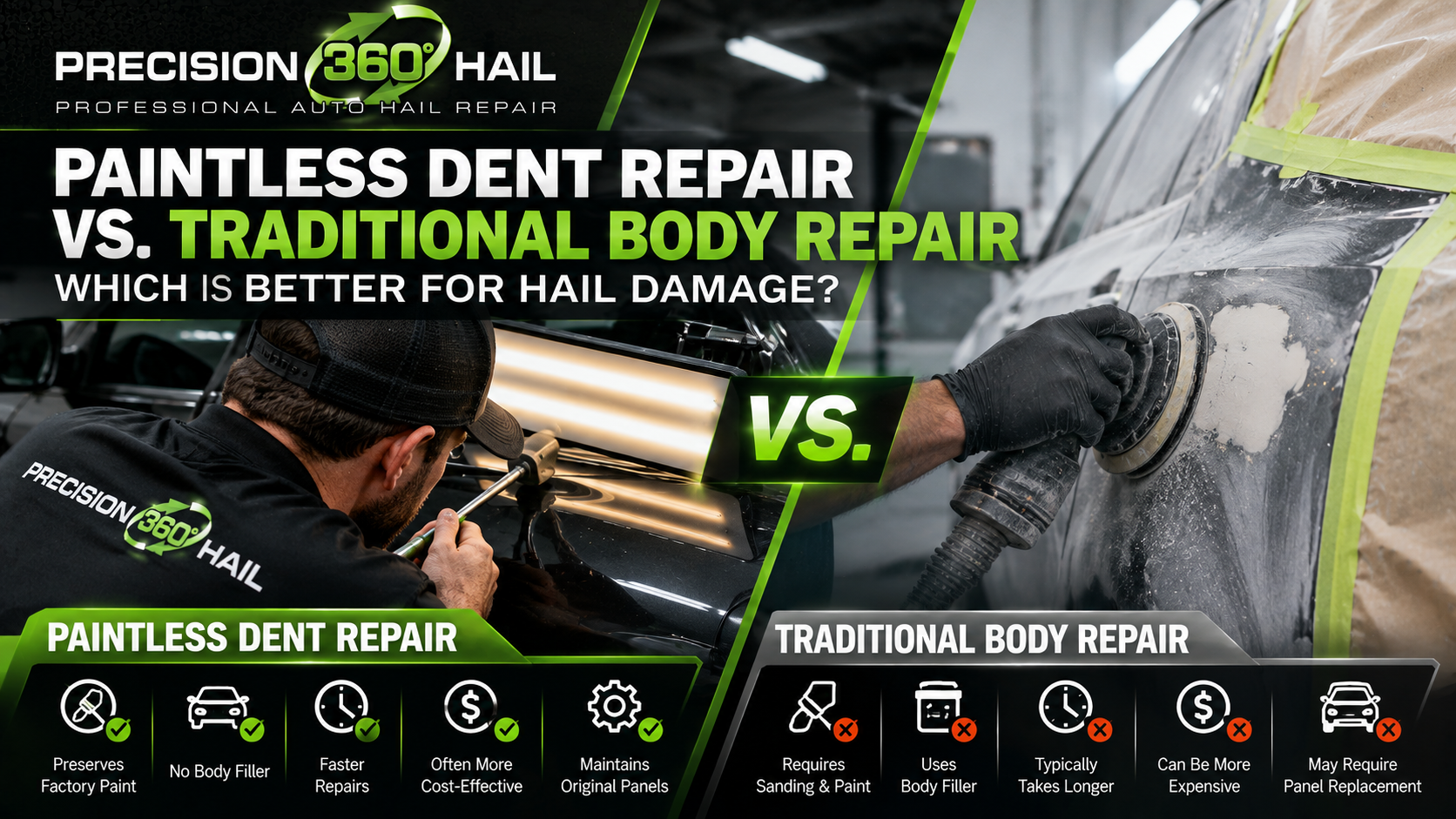
When the damage qualifies, Paintless Dent Repair (PDR) is often the preferred method for repairing automotive hail damage.
Instead of sanding the panel, applying body filler, and repainting the surface, PDR uses specialized tools and techniques to carefully manipulate the damaged metal toward its original shape.
For qualifying damage, this can provide several important advantages.
It can:
- Preserve the original factory paint
- Maintain the original panel
- Avoid unnecessary body filler
- Avoid repainting qualifying panels
- Repair numerous hail dents across the same vehicle
Because hail often creates many dents while leaving the paint intact, PDR is particularly well suited to automotive hail damage.
However, not every dent can be repaired using PDR.
When Hail Damage Requires More Than PDR
Some hail damage is too severe or involves conditions that make Paintless Dent Repair inappropriate for part of the vehicle.
Examples can include:
- Cracked or damaged paint
- Severely stretched metal
- Extremely deep impacts
- Damage to previously repaired areas
- Damaged trim or moldings
- Broken exterior components
- Damage requiring panel replacement
- Areas where conventional body repair is the appropriate method
In those situations, the repair plan may combine PDR with conventional repair, refinishing, replacement parts, or other necessary operations.
That’s another reason there’s no universal price for hail damage repair.
Two vehicles with a similar number of dents can require very different repair methods.
Accessing the Dents Can Affect the Repair Cost
Repairing a hail dent isn’t always as simple as placing a tool behind the panel.
Modern vehicles contain structural braces, wiring, airbags, headliners, interior trim, lights, cameras, sensors, and other components that can affect access.
In some cases, technicians may need to remove and reinstall certain components to properly access damaged panels.
For example, roof repairs may require access behind the headliner. Other panels may require removal of trim or related components.
These operations are part of the overall repair process and can affect the amount of labor involved.
Vehicle Construction Can Affect the Repair
Not every vehicle is built the same way.
Different manufacturers and models use different panel designs, materials, reinforcement structures, and construction techniques.
Some vehicles also use aluminum in certain exterior panels.
The repair approach depends on the actual vehicle and the material being repaired.
That’s why the year, make, model, damaged panels, and construction of the vehicle all matter when developing a hail repair plan.
Previous Repairs Can Change What’s Possible
Previous bodywork can also affect hail damage repair.
A panel that has already been repaired and refinished may behave differently from an original factory panel.
Previous repairs can involve:
- Body filler
- Repainted surfaces
- Previous dent repairs
- Replaced panels
- Altered panel structure
These conditions can affect whether PDR is appropriate and how the current hail damage should be repaired.
A professional inspection helps identify these issues before the repair begins.
Does Insurance Cover Hail Damage Repair?
Hail damage is commonly handled under the comprehensive portion of an auto insurance policy, subject to the terms, coverage, exclusions, and deductible of the individual policy.
Your insurance carrier determines whether a loss is covered.
If you’ve already filed a hail claim, your carrier may inspect the vehicle, request photographs, or prepare an initial repair estimate.
Precision 360 Hail can provide Insurance Claims Assistance related to the repair process, including inspection, repair documentation, estimates, and supplements when appropriate.
What If the Insurance Estimate Is Lower Than the Actual Repair Requirements?
This is an important part of understanding hail damage repair costs.
An insurance company’s initial estimate isn’t necessarily the final repair plan.
Hail damage can involve hundreds of individual dents, multiple panels, damaged components, and repair operations that may not all be accounted for during the initial estimate.
Additional requirements may also become apparent once technicians begin accessing damaged areas.
If Precision 360 Hail identifies additional necessary repair items that weren’t included in the original estimate, we can document those items and submit a supplement to the insurance carrier for review when appropriate.
The insurance company then determines whether the supplemental items are covered under the claim.
Your Deductible May Affect What You Pay Out of Pocket
If your insurance claim is covered, your deductible generally represents the portion of the covered loss you’re responsible for paying under your policy.
For example, someone with a $500 deductible and someone with a $1,000 deductible can have the exact same vehicle damage but different out-of-pocket responsibilities.
Precision 360 Hail offers up to $500 in Deductible Assistance on qualifying hail damage repairs, subject to eligibility and program terms.
The amount of assistance available depends on the individual repair and applicable program requirements.
If you’re concerned about your deductible, ask us about the program when scheduling your inspection.
Does a More Expensive Vehicle Automatically Cost More to Repair?
Not necessarily.
The value of the vehicle and the cost of repairing its hail damage are related in some situations, but vehicle price alone doesn’t determine repair cost.
What matters is what was damaged and what’s required to restore it.
A less expensive vehicle with hundreds of severe dents across multiple panels could require a more extensive repair than a higher-value vehicle with relatively minor damage.
The vehicle’s construction, panel materials, parts, technology, and repair procedures can also affect the repair.
That’s why the vehicle itself needs to be inspected.
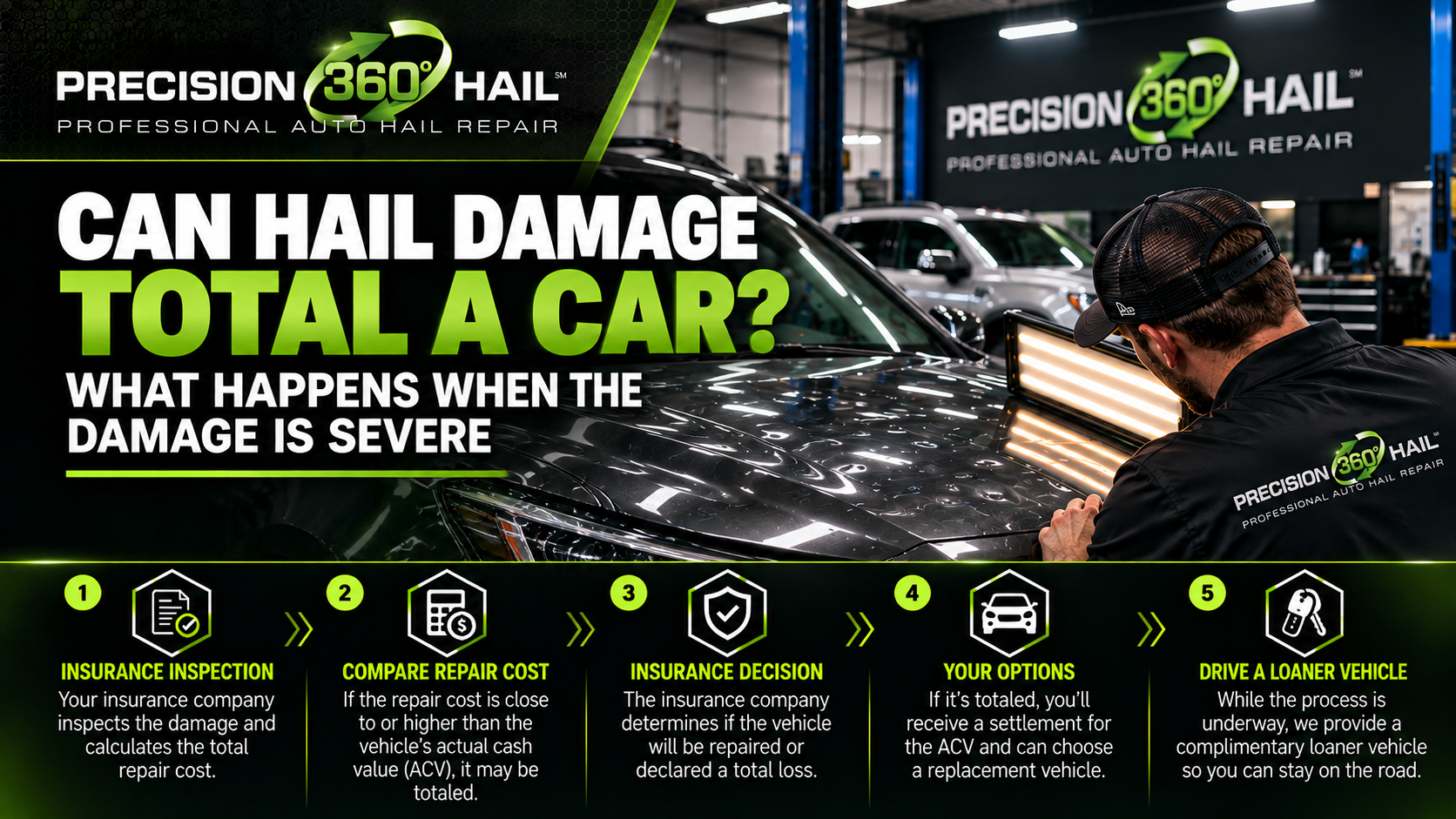
Can Hail Damage Become Expensive Enough to Total a Vehicle?
Yes, severe hail damage can sometimes result in a vehicle being declared a total loss.
But a vehicle that looks heavily dented isn’t automatically totaled.
Insurance carriers generally evaluate factors such as the vehicle’s value, repair cost, applicable state requirements, and other claim-specific considerations when making a total-loss determination.
The insurance carrier—not the repair facility—ultimately makes that decision.
We’ll cover this subject in much greater detail in another Precision 360 Hail article: Can Hail Damage Total a Car? What Happens When the Damage Is Severe.
Should You Get Multiple Hail Repair Estimates?
Price shouldn’t be the only thing you consider when choosing who repairs widespread hail damage.
Hail repair can involve hundreds of individual dents across multiple panels. Proper repair planning may require PDR, removal and installation procedures, parts, conventional repair, refinishing, and communication with the insurance carrier.
When comparing repair companies, consider:
- Experience with automotive hail damage
- Paintless Dent Repair capabilities
- Repair process
- Insurance claims assistance
- Repair documentation
- Warranty coverage
- Transportation options
- Communication throughout the repair
- Overall quality of the finished repair
The cheapest number isn’t necessarily the same thing as the correct repair plan.
Why We Don’t Give You a Made-Up Hail Repair Price
It would be easy to publish a chart that says a small hail repair costs this much, a medium repair costs that much, and severe damage costs another amount.
But that wouldn’t tell you what your vehicle needs.
The honest answer is that hail damage repair cost depends on the actual damage.
Precision 360 Hail would rather inspect the vehicle and determine what it needs than give you a generic number that may have little connection to the actual repair.
Start With a Professional Hail Damage Inspection
If your vehicle was caught in a hailstorm, you don’t need to figure out the repair cost by counting dents in your driveway.
Start with an inspection.
Precision 360 Hail can evaluate:
- The extent of the hail damage
- The affected panels
- Whether Paintless Dent Repair is appropriate
- Whether additional repair methods are necessary
- Repair-related insurance documentation
- Whether deductible assistance may be available
- Transportation options during the repair
If you’ve already filed an insurance claim, bring your claim information and insurance estimate with you.
We’ll inspect the vehicle and help you understand the next step.
Don’t Guess What Your Hail Damage Will Cost
A few visible dents don’t tell the whole story.
Neither does an online price calculator.
The number of dents, their size and location, affected panels, paint condition, panel access, vehicle construction, repair method, replacement components, and insurance-related repair requirements can all affect the final cost.
The best way to know what your vehicle actually needs is to have it professionally inspected.
Hail Damage? Let’s Find Out What It Actually Takes To Fix It.